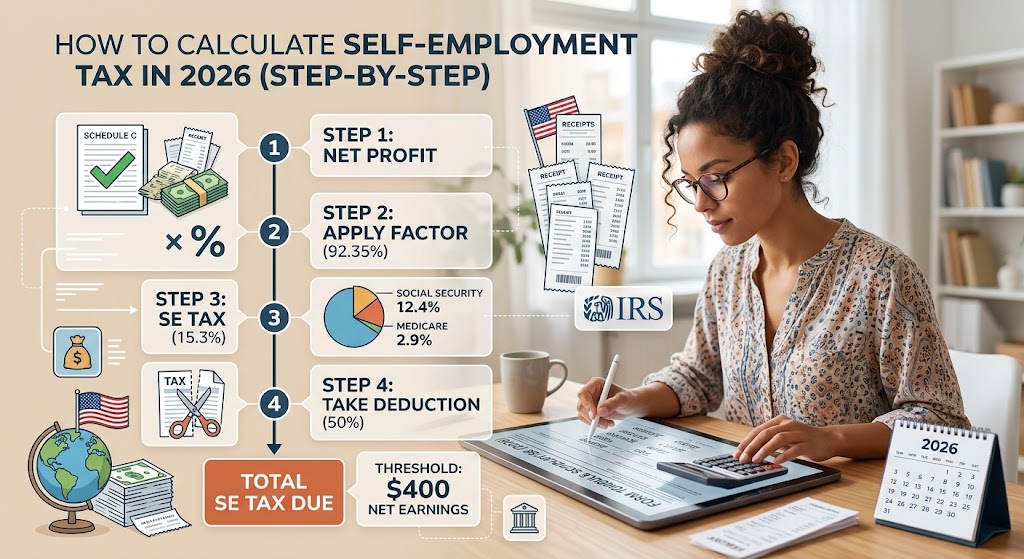
If you’re self-employed, self-employment tax is generally a separate federal tax in addition to regular income tax. For many freelancers, it is calculated by applying the 12.4% Social Security and 2.9% Medicare rates to 92.35% of net self-employment profit—not gross revenue. The Social Security portion is capped, W-2 wages can reduce how much of your self-employment income is subject to that portion, and higher earners may also owe Additional Medicare Tax.
Quick Answer
For a typical freelancer with no W-2 wages and earnings below the 2026 Social Security wage base, the basic calculation is:
- 1. Start with net business profit.
- 2. Multiply it by **92.35%** to estimate net earnings from self-employment.
- 3. Apply **12.4% for Social Security** and **2.9% for Medicare**.
- 4. Add the two amounts together.
For 2026, the Social Security wage base is **$184,500**. Medicare has no comparable wage ceiling.
The calculation becomes more nuanced if you also earn W-2 wages, if your income is high enough for Additional Medicare Tax, or if special self-employment tax rules apply.
What Is Self-Employment Tax?
Self-employment tax funds the same two federal programs that FICA taxes fund for employees: Social Security and Medicare.
When you work as an employee, you and your employer generally each pay 7.65% through payroll taxes. When you work for yourself, you generally pay the combined self-employment tax yourself.
It is important to keep three separate concepts straight:
- **Self-employment tax** funds Social Security and Medicare and is generally calculated on Schedule SE.
- **Federal income tax** is calculated separately on taxable income using the regular federal income-tax rules.
- **Quarterly estimated tax payments** are not a separate tax. They are a payment mechanism that many self-employed taxpayers use to pay expected income tax and self-employment tax during the year when withholding is not sufficient.
If you need a detailed guide to the payment process, see [How to Pay Quarterly Estimated Taxes as a Freelancer](/quarterly-estimated-taxes-freelancers/).
Who Has to Pay Self-Employment Tax?
The IRS generally requires self-employment tax when your **net earnings from self-employment are $400 or more** for the year.
For a typical sole proprietor, Schedule C is used to calculate business profit or loss, and Schedule SE is then used to calculate net earnings from self-employment and the tax due.
**Examples:**
- **A freelance copywriter** with $35,000 of Schedule C net profit will generally owe self-employment tax. The tax is not simply 15.3% of the full $35,000; Schedule SE generally applies the 92.35% adjustment first.
- **A DoorDash or Uber driver** is generally subject to the same self-employment tax rules as other independent contractors. Legitimate business expenses—such as deductible vehicle expenses where applicable—reduce business profit before the self-employment tax calculation.
- **Someone with both a W-2 job and freelance income** can still owe self-employment tax on the freelance activity. W-2 wages matter when determining how much of the self-employment income remains subject to the Social Security portion.
- **Someone with only a very small amount of side income** may fall below the threshold. For example, $250 of net profit would ordinarily remain below the $400 net-earnings threshold after the standard 92.35% adjustment, although other filing obligations can still apply.
There are special rules for certain taxpayers, including some church employees, ministers, members of religious orders, and people using optional methods for figuring net earnings. This guide focuses on the rules that apply to a typical freelancer, independent contractor, or gig worker.
*This is general educational information, not individualized tax advice.*
What Is the Self-Employment Tax Rate in 2026?
The regular self-employment tax rate is **15.3%**, made up of:
- **12.4% for Social Security**
- **2.9% for Medicare**
The two components do not operate exactly the same way.
Social Security portion
For 2026, the maximum amount of combined wages and net earnings from self-employment subject to Social Security tax is **$184,500**.
If you already have W-2 wages subject to Social Security tax, those wages use part—or all—of that $184,500 limit before the Social Security portion of self-employment tax is calculated.
Medicare portion
The regular **2.9% Medicare portion has no wage-base ceiling**. Net earnings from self-employment remain subject to this portion even after the Social Security wage base has been reached.
Higher-income taxpayers may also owe the separate **0.9% Additional Medicare Tax**, discussed later in this guide.
Why 92.35% of net profit?
For a typical Schedule C business, self-employment tax is generally calculated on **92.35% of net profit**, not gross revenue and not 100% of Schedule C profit.
The 92.35% factor reflects the employer-equivalent adjustment built into the self-employment tax rules.
How to Calculate Self-Employment Tax Step by Step
For a typical sole proprietor or single-member LLC that has not elected corporate tax treatment:
- 1. **Calculate gross business income.**
- 2. **Subtract deductible business expenses** to determine Schedule C net profit.
- 3. **Multiply net profit by 92.35%** to estimate net earnings from self-employment.
- 4. **Calculate the Social Security portion** at 12.4%, subject to the 2026 $184,500 wage base and reduced by W-2 Social Security wages where applicable.
- 5. **Calculate the Medicare portion** at 2.9% of net earnings from self-employment.
- 6. **Add the Social Security and Medicare amounts** to determine regular self-employment tax.
- 7. **Calculate the deductible half of regular self-employment tax** for the adjustment to income.
The examples below use rounded dollar amounts for readability.
Self-Employment Tax Example: $60,000 Net Profit
Assume Jordan is a single freelance graphic designer with **$60,000 of Schedule C net profit** and no W-2 wages.
Jordan’s net earnings are well below the 2026 Social Security wage base, so the full $55,410 is subject to both the 12.4% Social Security portion and the 2.9% Medicare portion.
The approximately $4,239 deduction does **not** reduce Jordan’s $8,478 self-employment tax. Instead, it is an adjustment to income that can reduce adjusted gross income for federal income-tax purposes.
Example: Freelancer With W-2 Income and Side Income
Assume Priya is single, has **$170,000 of W-2 wages subject to Social Security and Medicare tax**, and also earns **$30,000 of Schedule C net profit** from freelance consulting.
Her W-2 Social Security wages use most of the 2026 Social Security wage base before her self-employment income is considered.
Priya’s full $27,705 of net earnings remains subject to the regular 2.9% Medicare portion because Medicare has no wage-base ceiling.
Only $14,500 is subject to the 12.4% Social Security portion because her W-2 wages already used $170,000 of the $184,500 limit.
If her W-2 Social Security wages had already reached or exceeded $184,500, none of her self-employment earnings would be subject to the 12.4% Social Security portion, but the regular 2.9% Medicare portion would still apply.
How the Half of Self-Employment Tax Deduction Works
One of the most common misunderstandings is that deducting half of self-employment tax means you only pay half the tax.
It does not.
The IRS allows a deduction equal to **50% of regular self-employment tax** as an adjustment to income.
Using Jordan’s example:
- Regular self-employment tax: about **$8,478**
- Deduction used when calculating adjusted gross income: about **$4,239**
Jordan still owes the full regular self-employment tax. The deduction affects the separate federal income-tax calculation.
Does Self-Employment Tax Replace Federal Income Tax?
No.
Self-employed taxpayers can owe both self-employment tax and federal income tax.
A freelancer with $60,000 of net profit does not simply pay the approximately $8,478 of self-employment tax from the example above. They may also owe federal income tax after deductions, adjustments, credits, and other applicable tax rules are taken into account.
How Self-Employment Tax Affects Quarterly Estimated Taxes
Self-employment tax is part of the broader federal tax liability many freelancers need to plan for during the year.
If your withholding and credits are not enough to cover the required amount, you may need to make estimated tax payments.
That estimate can include:
- expected federal income tax;
- expected self-employment tax;
- other applicable federal taxes;
- expected withholding and credits.
This is why simply estimating income tax and ignoring self-employment tax can leave a freelancer short at filing time.
For the full payment process, see [How to Pay Quarterly Estimated Taxes as a Freelancer](/quarterly-estimated-taxes-freelancers/).
Schedule C vs. Schedule SE
For a typical sole proprietor or individual owner of a single-member LLC that is treated as a disregarded entity:
- **Schedule C (Profit or Loss From Business)** reports business income and deductible business expenses and calculates net profit or loss.
- **Schedule SE (Self-Employment Tax)** uses self-employment income to calculate Social Security and Medicare tax.
Not every type of self-employment income is reported on Schedule C. Partnership income, farming income, and certain special categories can follow different reporting paths.
What About Additional Medicare Tax?
Additional Medicare Tax is a **separate 0.9% tax**. It is not part of the regular 15.3% self-employment tax rate.
The thresholds are based on filing status:
When a taxpayer has both Medicare wages and self-employment income, the IRS applies a specific calculation:
- 1. Determine whether Medicare wages exceed the filing-status threshold.
- 2. Reduce the applicable threshold by Medicare wages, but not below zero.
- 3. Apply the 0.9% tax to self-employment income above the remaining threshold.
Using Priya’s example and assuming her $170,000 of W-2 wages are also Medicare wages:
- Single threshold: **$200,000**
- Medicare wages: **$170,000**
- Remaining threshold: **$30,000**
- Net earnings from self-employment: **$27,705**
Because $27,705 does not exceed the remaining $30,000 threshold, Priya would not owe Additional Medicare Tax on the self-employment income in this simplified example.
Additional Medicare Tax is calculated on **Form 8959**, not by changing the regular 15.3% self-employment tax rate.
Common Self-Employment Tax Mistakes
- **Applying 15.3% directly to gross revenue.** Business expenses and the 92.35% adjustment matter.
- **Confusing Schedule C net profit with net earnings from self-employment.**
- **Forgetting legitimate Schedule C business expenses.**
- **Confusing self-employment tax with federal income tax.**
- **Ignoring W-2 Social Security wages when applying the wage base.**
- **Believing the half-SE-tax deduction cuts the tax itself in half.**
- **Forgetting Additional Medicare Tax at higher income levels.**
- **Waiting until filing season to plan for taxes.**
How to Reduce Self-Employment Tax Legally
There is no legitimate trick that simply makes self-employment tax disappear. But accurate business reporting and, in some cases, business structure can affect the amount subject to employment taxes.
Deduct legitimate business expenses
Ordinary and necessary expenses properly deductible on Schedule C can reduce net business profit and therefore reduce the amount used in the regular self-employment tax calculation.
Expenses must actually qualify under the tax rules and should be properly documented.
Understand what an LLC does—and does not do
A single-member LLC that is treated as a disregarded entity for federal income-tax purposes is generally subject to self-employment tax in the same manner as a sole proprietorship.
Simply forming an LLC does not automatically eliminate self-employment tax.
Be careful with S corporation tax claims
An S corporation can change how an owner who works in the business is compensated, but it is not an automatic tax-saving strategy.
The IRS requires an S corporation to pay **reasonable compensation** to a shareholder-employee for services performed before treating additional amounts as non-wage distributions.
An S corporation also adds payroll, tax filing, bookkeeping, and compliance obligations. Whether an election makes financial sense depends on the facts and should generally be evaluated with a qualified tax professional.
Self-Employment Tax Checklist
- [ ] Calculate business income and deductible expenses.
- [ ] Determine Schedule C net profit if Schedule C applies to your business.
- [ ] Apply the 92.35% adjustment when calculating regular net earnings from self-employment.
- [ ] Check whether net earnings reach the $400 general threshold.
- [ ] If you also have W-2 wages, account for wages already subject to Social Security tax.
- [ ] Calculate the 12.4% Social Security portion, subject to the 2026 $184,500 wage base.
- [ ] Calculate the regular 2.9% Medicare portion.
- [ ] Add the two components to estimate regular self-employment tax.
- [ ] Calculate the deduction for one-half of regular self-employment tax.
- [ ] Separately estimate federal income tax.
- [ ] Check whether Additional Medicare Tax may apply.
- [ ] Include expected self-employment tax when planning estimated tax payments.
Frequently Asked Questions
Is self-employment tax 15.3% of all my income?
No. For a typical freelancer below the Social Security wage base, the regular self-employment tax calculation generally starts with 92.35% of net self-employment profit, not gross revenue.
The 12.4% Social Security portion is also subject to the annual wage base.
Do I pay self-employment tax if I also have a W-2 job?
You can.
Your W-2 wages count toward the Social Security wage base first. That can reduce or eliminate the 12.4% Social Security portion on your self-employment income.
The regular 2.9% Medicare portion generally still applies to net earnings from self-employment.
Do I pay self-employment tax on gross or net income?
For a typical Schedule C business, the calculation starts with **net profit after deductible business expenses**, followed by the 92.35% adjustment used to calculate net earnings from self-employment.
Is self-employment tax deductible?
The IRS generally allows a deduction equal to one-half of regular self-employment tax when calculating adjusted gross income.
That deduction does not reduce the self-employment tax itself.
Do Uber and DoorDash drivers pay self-employment tax?
They generally do if their net earnings from self-employment reach the applicable threshold.
Gig workers should calculate business profit after eligible business expenses rather than applying 15.3% directly to the amount shown on a payment app or gross earnings statement.
What happens if I earn less than $400?
The general rule is based on **net earnings from self-employment**, not simply gross receipts.
If net earnings from self-employment are below $400, you generally do not owe regular self-employment tax under the standard rule, although other tax-return filing or income-reporting requirements may still apply.
Is self-employment tax the same as quarterly taxes?
No.
Self-employment tax is a tax. Estimated tax payments are a method for paying expected federal tax liability throughout the year.
Can an LLC avoid self-employment tax?
Not by itself.
An individual owner of a single-member LLC that is disregarded for federal income-tax purposes is generally subject to self-employment tax in the same manner as a sole proprietor.
Different tax elections can change the analysis, but they also add legal, payroll, accounting, and compliance considerations.
Bottom Line
For many freelancers with no W-2 wages and earnings below the Social Security wage base, regular self-employment tax is calculated by applying the 12.4% Social Security and 2.9% Medicare rates to 92.35% of net self-employment profit.
But the simple 15.3% formula is not universal. W-2 wages can reduce the Social Security portion, the Social Security wage base caps that portion, and higher-income taxpayers may owe the separate 0.9% Additional Medicare Tax.
The most important practical distinction is this: **self-employment tax, federal income tax, and estimated tax payments are related, but they are not the same thing.**
*This article is for general educational purposes and reflects federal rules applicable to the 2026 tax year at the time of publication. It is not individualized tax, legal, accounting, or investment advice. Tax rules and individual circumstances can change. Consider consulting a CPA, enrolled agent, attorney, or other qualified professional for advice about your specific situation.*
Official Sources
- [IRS — Topic No. 554, Self-Employment Tax](https://www.irs.gov/taxtopics/tc554)
- [IRS — Schedule C & Schedule SE](https://www.irs.gov/faqs/small-business-self-employed-other-business/schedule-c-schedule-se)
- [IRS — 2026 Form 1040-ES](https://www.irs.gov/pub/irs-prior/f1040es–2026.pdf)
- [IRS — Topic No. 560, Additional Medicare Tax](https://www.irs.gov/taxtopics/tc560)
- [IRS — Questions and Answers for the Additional Medicare Tax](https://www.irs.gov/businesses/small-businesses-self-employed/questions-and-answers-for-the-additional-medicare-tax)
- [IRS — Single Member Limited Liability Companies](https://www.irs.gov/businesses/small-businesses-self-employed/single-member-limited-liability-companies)
- [IRS — S Corporation Compensation and Medical Insurance Issues](https://www.irs.gov/businesses/small-businesses-self-employed/s-corporation-compensation-and-medical-insurance-issues)
- [Social Security Administration — Contribution and Benefit Base](https://www.ssa.gov/oact/cola/cbb.html)