
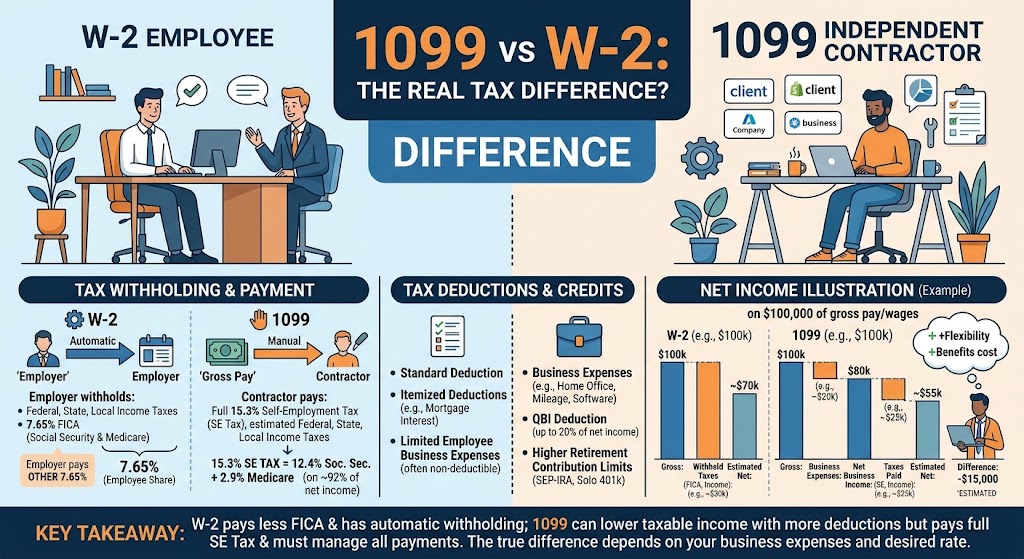
W-2 employees generally have federal income tax and payroll taxes withheld from each paycheck, while independent contractors usually receive payments without regular federal withholding and handle their own tax payments. Employers also generally pay a matching share of Social Security and Medicare taxes for employees; self-employed workers generally cover both shares through self-employment tax.
That is the core tax difference between W-2 employment and 1099 contracting — but it is not the whole financial comparison. Business deductions, benefits, retirement plans, health insurance, paid time off, and the legal rules that determine worker classification can all matter.
Quick Answer
A W-2 employee generally has federal income tax and the employee share of Social Security and Medicare taxes withheld from wages. The employer separately pays its own Social Security and Medicare share.
A 1099 independent contractor is generally treated as self-employed for federal tax purposes. Clients usually do not withhold federal income tax or payroll taxes from ordinary contractor payments, so the contractor may need to make estimated tax payments and generally calculates self-employment tax on net earnings.
For many self-employed people below the Social Security wage base, the regular self-employment tax rate is 15.3%, applied to 92.35% of net earnings from self-employment. The Social Security portion is subject to an annual limit, and Additional Medicare Tax can apply at higher income levels.
One important distinction: a Form 1099 does not decide whether someone is legally an independent contractor. Worker status depends on the actual relationship and the law that applies.
What Is a W-2 Employee?
Form W-2 is the wage statement employers generally provide to employees after the end of the year. It reports wages and amounts withheld, including federal income tax and payroll taxes.
For a typical employee, the employer generally:
- Withholds federal income tax based in part on the employee’s Form W-4
- Withholds the employee share of Social Security and Medicare taxes
- Pays the employer share of Social Security and Medicare taxes
- Pays federal unemployment tax when applicable and handles state unemployment obligations under applicable state law
- Complies with employment-law requirements that apply to the worker and workplace
Employees may also receive benefits such as health insurance, retirement-plan access, paid leave, or employer retirement contributions. Those benefits are not universal, but they can materially change the value of a W-2 compensation package.
What Is a 1099 Independent Contractor?
An independent contractor is generally in business for themselves rather than working as an employee of the payer. Contractors often have meaningful control over how they perform their work, may serve multiple clients, and are responsible for many of their own business expenses. However, no single fact determines classification.
For payments made in 2026, businesses generally must issue Form 1099-NEC when they pay at least $2,000 in reportable nonemployee compensation, subject to the form’s rules and exceptions. The reporting threshold was $600 for payments made before 2026 and is scheduled to be inflation-adjusted after 2026.
The reporting threshold does not determine whether income is taxable. A contractor can have taxable business income even when no Form 1099-NEC is issued. Backup-withholding rules can also require a Form 1099-NEC regardless of the payment amount.
Many sole-proprietor contractors:
- Report business income and deductible business expenses on Schedule C
- Calculate self-employment tax on Schedule SE
- Receive client payments without regular federal tax withholding
- May need to make estimated tax payments during the year
- Can deduct ordinary and necessary business expenses when the tax rules allow them
For a detailed calculation, see How to Calculate Self-Employment Tax in 2026. For estimated payments, see How to Pay Quarterly Estimated Taxes as a Freelancer.
1099 vs W-2: Side-by-Side Comparison
| Feature | W-2 Employee | 1099 Independent Contractor |
|---|---|---|
| Federal tax withholding | Employer generally withholds from wages | Usually no regular withholding from client payments; exceptions such as backup withholding can apply |
| Social Security and Medicare | Employee pays the employee share; employer generally pays a matching share at standard rates | Generally pays self-employment tax covering both shares |
| Estimated tax payments | Often unnecessary if withholding is sufficient | May be required if the IRS estimated-tax tests are met |
| Business expenses | Most employees cannot deduct ordinary unreimbursed employee business expenses on the federal return; limited exceptions exist | Ordinary and necessary business expenses may reduce Schedule C profit |
| Benefits | May receive health insurance, paid leave, retirement benefits, and other employer benefits | Usually must arrange and fund benefits independently |
| Retirement | May have access to an employer plan such as a 401(k); personal IRA rules can also apply | May be able to establish a SEP, SIMPLE IRA, or one-participant 401(k), depending on eligibility; personal IRA rules can also apply |
| Health insurance | May have employer-sponsored coverage | May use Marketplace, spouse, or individual coverage; a self-employed health insurance deduction may be available |
| Unemployment | May qualify under state unemployment rules | Generally outside regular employee unemployment systems, subject to state law and special programs |
| Workers’ compensation | Coverage is generally governed by state law and often applies to employees | Coverage varies by state and arrangement; contractors may need separate protection |
| Worker classification | Depends on the actual relationship and applicable law | Depends on the actual relationship and applicable law — not merely the contract label or tax form |
| Common federal tax forms | Form W-2 and Form 1040 | Form 1099-NEC when applicable; many sole proprietors use Schedule C, Schedule SE, and Form 1040 |
State law can change important parts of this comparison, especially worker classification, unemployment insurance, and workers’ compensation.
The Tax Difference: Who Pays Social Security and Medicare?
For most W-2 employees, the standard payroll-tax split is:
- 6.2% Social Security paid by the employee, up to the annual Social Security wage base
- 1.45% Medicare paid by the employee, with no wage cap
- The employer generally pays matching 6.2% Social Security and 1.45% Medicare amounts
That gives the familiar 7.65% employee share and 7.65% employer share at earnings levels below the Social Security wage base.
For self-employed workers, the regular self-employment tax rate is 15.3%: 12.4% for Social Security and 2.9% for Medicare. The IRS generally applies that rate to 92.35% of net earnings from self-employment, subject to the Social Security limit and other rules.
2026 Social Security Wage Base
For 2026, the Social Security taxable maximum is $184,500. The Social Security portion of payroll or self-employment tax does not continue indefinitely above that annual limit. Medicare tax does not have the same wage cap.
Additional Medicare Tax
A separate 0.9% Additional Medicare Tax can apply when Medicare wages, self-employment income, and certain railroad retirement compensation exceed the applicable filing-status threshold:
- $200,000 for single, head of household, and qualifying surviving spouse filers
- $250,000 for married filing jointly
- $125,000 for married filing separately
For employees, an employer generally starts withholding Additional Medicare Tax after paying an employee more than $200,000 in Medicare wages during the calendar year, regardless of the employee’s filing status. The employee’s final liability is still based on the filing-status thresholds above. There is no employer match for the 0.9% Additional Medicare Tax.
Example: $60,000 W-2 Salary vs $60,000 of Self-Employment Net Profit
To isolate the payroll-tax difference, compare $60,000 of W-2 wages with $60,000 of net profit from self-employment. Net profit means business expenses have already been deducted. Comparing $60,000 of contractor revenue with $60,000 of employee wages would not be an apples-to-apples comparison.
| W-2 Employee | Self-Employed Contractor | |
|---|---|---|
| Income used in example | $60,000 wages | $60,000 net profit |
| Worker-paid standard Social Security and Medicare tax | $4,590 | About $8,478 of self-employment tax |
| Employer-paid standard Social Security and Medicare tax | $4,590 paid separately by employer | No separate employer payment |
The contractor calculation is approximately:
$60,000 × 92.35% × 15.3% = $8,477.73
At this income level, the employee sees $4,590 withheld for the standard employee Social Security and Medicare share, while the employer separately pays another $4,590. The self-employed worker personally pays the approximately $8,478 self-employment tax.
This example is intentionally limited. It does not compare total federal income tax, state taxes, business expenses, tax credits, retirement contributions, health insurance costs, or the value of employee benefits. Those items can materially change the overall result.
Does a 1099 Worker Always Pay More Tax?
No. Independent contractors generally shoulder more of the Social Security and Medicare tax themselves, but that does not prove that every contractor pays more total tax or ends up with less after-tax value.
Several factors can change the comparison:
- Business expenses: qualifying Schedule C expenses can reduce business profit and therefore may reduce both federal income tax and self-employment tax.
- Deduction for one-half of self-employment tax: self-employed taxpayers can generally deduct the deductible portion of self-employment tax when calculating adjusted gross income. This does not reduce the self-employment tax itself.
- Qualified Business Income deduction: the Section 199A deduction was made permanent for 2026 and later years. Some eligible business owners may qualify, but the calculation is subject to income, business-type, wage/property, and other rules.
- Contractor rate: a contractor rate may be higher than an employee salary because the contractor may be responsible for taxes, insurance, unpaid time, tools, and administration.
- Employee benefits: health coverage, retirement contributions, paid leave, and other benefits can make a W-2 package more valuable than its salary alone suggests.
The better comparison is total compensation and total costs, not simply 7.65% versus 15.3%.
Business Deductions: A Major Difference
Many independent contractors operating as sole proprietors can deduct ordinary and necessary business expenses on Schedule C. Examples can include:
- Business software and subscriptions
- Office supplies and qualifying equipment
- Business mileage or vehicle expenses when eligible
- A qualifying home office
- Professional fees
- Business insurance
Not every expense is deductible, and personal expenses do not become deductible simply because someone is self-employed. The tax treatment also differs for some larger purchases, mixed personal/business expenses, and specialized deductions.
For W-2 employees, the federal deduction for miscellaneous unreimbursed employee business expenses that were subject to the old 2%-of-AGI floor is generally disallowed, with limited statutory exceptions for certain categories of workers.
Quarterly Estimated Taxes for 1099 Workers
Because client payments usually do not include regular federal income-tax withholding, many self-employed workers need to pay tax during the year through estimated payments.
For individuals, the IRS generally says estimated tax payments are required when both of these conditions apply:
- You expect to owe at least $1,000 in tax for the year after subtracting withholding and refundable credits, and
- Your withholding and refundable credits are expected to be less than the smaller of 90% of the current year’s tax or 100% of the prior year’s tax — generally 110% of prior-year tax for certain higher-income taxpayers.
There are special rules and exceptions, so owing any amount at filing time does not automatically mean quarterly estimated payments were required.
See How to Pay Quarterly Estimated Taxes as a Freelancer for a step-by-step explanation.
Self-Employment Tax for 1099 Workers
The IRS generally requires self-employment tax when net earnings from self-employment are $400 or more, subject to special rules for certain situations. The tax helps fund Social Security and Medicare for self-employed people and generally covers the combined employee-and-employer rate rather than only one side of payroll tax.
See How to Calculate Self-Employment Tax in 2026 for the calculation, including the 92.35% adjustment and Social Security wage base.
Benefits and Hidden Compensation
A salary or contract rate is only one part of compensation. When comparing a W-2 offer with an independent-contractor arrangement, consider the value or cost of:
- Health insurance: an employer may subsidize part of the premium.
- Retirement contributions: some employers make matching or other contributions.
- Paid time off: contractors generally do not bill a client for vacation, holidays, or sick days unless the contract specifically provides otherwise.
- Payroll taxes: employers generally pay their share of Social Security and Medicare taxes for employees.
- Unemployment and workers’ compensation systems: employee coverage and eligibility depend heavily on state law.
- Equipment and software: contractors often pay for their own business tools.
- Administrative time: invoicing, bookkeeping, tax planning, and client acquisition take time that may not be billable.
Retirement: W-2 vs 1099
A W-2 employee may have access to an employer-sponsored retirement plan such as a 401(k), sometimes with employer contributions.
Self-employed business owners can have different options. Depending on the business and eligibility rules, these can include a SEP, SIMPLE IRA, or one-participant 401(k). A one-participant 401(k) is generally designed for a business owner with no employees other than a spouse. Traditional and Roth IRA rules can also apply to both employees and self-employed individuals.
Contribution limits and eligibility rules change over time, so retirement-plan decisions should be based on current IRS guidance rather than a generic comparison.
Health Insurance: W-2 vs 1099
W-2 employees may receive employer-sponsored health insurance, sometimes with part of the premium paid by the employer.
Self-employed people may obtain coverage through the Health Insurance Marketplace, a spouse’s employer plan, or another individual policy. Some self-employed taxpayers may also qualify for the self-employed health insurance deduction. The IRS uses Form 7206 to calculate the deduction, and eligibility limitations apply.
Can You Choose to Be 1099 Instead of W-2?
Not simply by agreeing to a label.
For federal employment-tax purposes, the IRS looks at the entire relationship between the worker and the business. Its common-law framework groups relevant facts into three broad categories:
- Behavioral control: who has the right to direct and control what work is done and how it is done?
- Financial control: who controls the business and financial aspects of the work, such as payment methods, unreimbursed expenses, and tools?
- Type of relationship: what do contracts, benefits, permanency, and the role of the services in the business indicate?
No single factor automatically decides the result. The IRS says businesses must examine the relationship as a whole.
If the classification remains unclear, either the business or the worker can file Form SS-8 and ask the IRS for a determination for federal employment-tax and income-tax-withholding purposes. The IRS warns that receiving a determination can take at least six months.
IRS Rules Are Not the Only Classification Rules
The IRS test is for federal tax purposes. Other laws can use different standards. For example, the Fair Labor Standards Act uses an economic-reality analysis for federal wage-and-hour purposes, and state laws may apply their own tests.
As of September 8, 2026, the U.S. Department of Labor’s framework is in transition. The Wage and Hour Division says it is not applying the 2024 independent-contractor rule in its investigations, while DOL materials state that the 2024 rule remains in effect for private litigation. DOL proposed a replacement rule on February 26, 2026, but that proposal has not been finalized on the Department’s current rulemaking page.
That means someone dealing with an actual classification dispute should check the current DOL and state-law standards rather than relying on a single tax test.
What Happens If a Worker Is Misclassified?
Misclassification can create tax and employment-law consequences.
For a business, the IRS may assess employment taxes when a worker treated as an independent contractor should have been treated as an employee. Penalties and interest can also apply depending on the facts.
For a worker, misclassification can affect tax withholding and may also affect rights or benefits that depend on employee status. Form SS-8 can be used to request an IRS status determination, and Form 8919 may apply in certain cases involving Social Security and Medicare tax for workers who were treated as independent contractors.
State tax, wage-and-hour, unemployment, and workers’ compensation consequences can differ substantially.
Anyone dealing with an actual classification dispute should consider advice from a qualified tax professional or employment attorney familiar with the applicable federal and state rules.
Which Is Better: 1099 or W-2?
There is no universal winner.
W-2 employment may be attractive when you value:
- Automatic tax withholding
- Employer-sponsored benefits
- Paid leave where offered
- Employer retirement contributions where offered
- Employee protections that apply under federal and state law
Independent contracting may be attractive when you value:
- Operating your own business
- Greater control over clients, pricing, or work methods when the arrangement genuinely provides it
- The ability to deduct qualifying business expenses
- Access to self-employed retirement-plan options
But preference does not override legal classification. If the facts make someone an employee under the applicable law, calling the arrangement “1099” does not automatically convert that person into an independent contractor.
Thinking about leaving your W-2 job to freelance full-time?
Use our Freelance Readiness Calculator to evaluate your income stability, savings, booked work, expenses and client concentration before making the jump.
Check Your Freelance Readiness →Common 1099 vs W-2 Mistakes
- Assuming every contractor pays more total tax. Self-employment tax is only one part of the overall calculation.
- Comparing contractor revenue with employee salary. Contractor business expenses need to be considered.
- Ignoring benefits. Employer-paid health coverage, retirement contributions, and paid leave can have substantial value.
- Ignoring business expenses. Eligible contractors should track legitimate business costs accurately.
- Assuming worker status is optional. Classification depends on the actual relationship and applicable law.
- Assuming any tax due means quarterly payments were required. Estimated-tax rules include the $1,000 threshold and safe-harbor tests.
- Treating Form 1099 as proof of contractor status. A tax form reports payments; it does not by itself settle legal classification.
1099 vs W-2 Checklist
- Confirm that the proposed worker classification fits the actual relationship.
- Compare W-2 salary with contractor net profit potential, not just gross contractor revenue.
- Estimate self-employment tax for the contractor side.
- Determine whether estimated payments may be required.
- Estimate the value of health insurance, retirement contributions, paid leave, and other benefits.
- Include business expenses, insurance, equipment, software, and unpaid administrative time.
- Check federal and state worker-classification rules when the relationship is unclear.
Frequently Asked Questions
Is 1099 better than W-2?
Not automatically. A contractor arrangement may provide more independence and potentially higher gross compensation, while W-2 employment may provide withholding, benefits, and employee protections. The better financial outcome depends on the actual pay, expenses, benefits, and tax situation — and the legal classification must still be correct.
Do 1099 workers pay more taxes?
Independent contractors generally pay both sides of Social Security and Medicare through self-employment tax, while W-2 employees generally pay only the employee share directly. That does not mean every contractor pays more total tax because business deductions, compensation, credits, and other tax rules can change the final result.
Can I be W-2 and 1099 at the same time?
Yes. A person can have an employee job and also earn separate self-employment income. The two types of income are reported differently. Schedule SE coordinates the annual Social Security wage base so W-2 wages can reduce the remaining amount of self-employment earnings subject to the Social Security portion of self-employment tax.
Can my employer switch me from W-2 to 1099?
A business can change how work is structured, but simply changing the label or tax form does not make an employee an independent contractor. The actual relationship must support contractor classification under the laws that apply.
Do 1099 workers get tax refunds?
They can. If estimated payments, withholding from another job, refundable credits, or other payments exceed the final tax liability, a self-employed taxpayer may receive a refund.
Can self-employed workers deduct health insurance?
Some can. The self-employed health insurance deduction is subject to eligibility and calculation rules. The IRS uses Form 7206 to determine the allowable deduction.
Do W-2 employees pay self-employment tax?
Not on their W-2 wages. Employees generally pay Social Security and Medicare taxes through payroll withholding. A W-2 employee who also has separate self-employment income may owe self-employment tax on that separate business income.
Does receiving a 1099 mean I am legally an independent contractor?
No. Form 1099 reports certain payments. Worker classification depends on the facts of the relationship and the legal test that applies.
Bottom Line
The basic tax difference is simple: W-2 employees generally split standard Social Security and Medicare taxes with an employer, while self-employed contractors generally pay the combined rate through self-employment tax on adjusted net earnings.
The real financial difference is broader. Business expenses, health insurance, retirement contributions, paid leave, equipment, administrative time, and the contractor’s rate all matter. And before comparing the money, make sure the classification itself is legally supportable — because a W-2 or 1099 label does not decide worker status by itself.
This article is for general educational purposes and is not individualized tax, legal, employment, or investment advice. Federal and state rules can change, and worker classification depends on specific facts.
Official Sources
- IRS — Topic No. 751, Social Security and Medicare Withholding Rates
- IRS — Topic No. 554, Self-Employment Tax
- IRS — Independent Contractor (Self-Employed) or Employee?
- IRS — Topic No. 762, Independent Contractor vs. Employee
- IRS — Form 1099 Reporting Requirements
- IRS — 2026 Instructions for Forms 1099-MISC and 1099-NEC
- IRS — Estimated Tax FAQs
- Social Security Administration — Contribution and Benefit Base
- IRS — Topic No. 560, Additional Medicare Tax
- IRS — Form SS-8
- IRS — Retirement Plans for Self-Employed People
- IRS — Form 7206, Self-Employed Health Insurance Deduction
- IRS — 2026 Tax Law Updates, Including the Permanent QBI Deduction
- U.S. Department of Labor — Field Assistance Bulletin 2025-1
- U.S. Department of Labor — 2026 Independent Contractor Rulemaking