
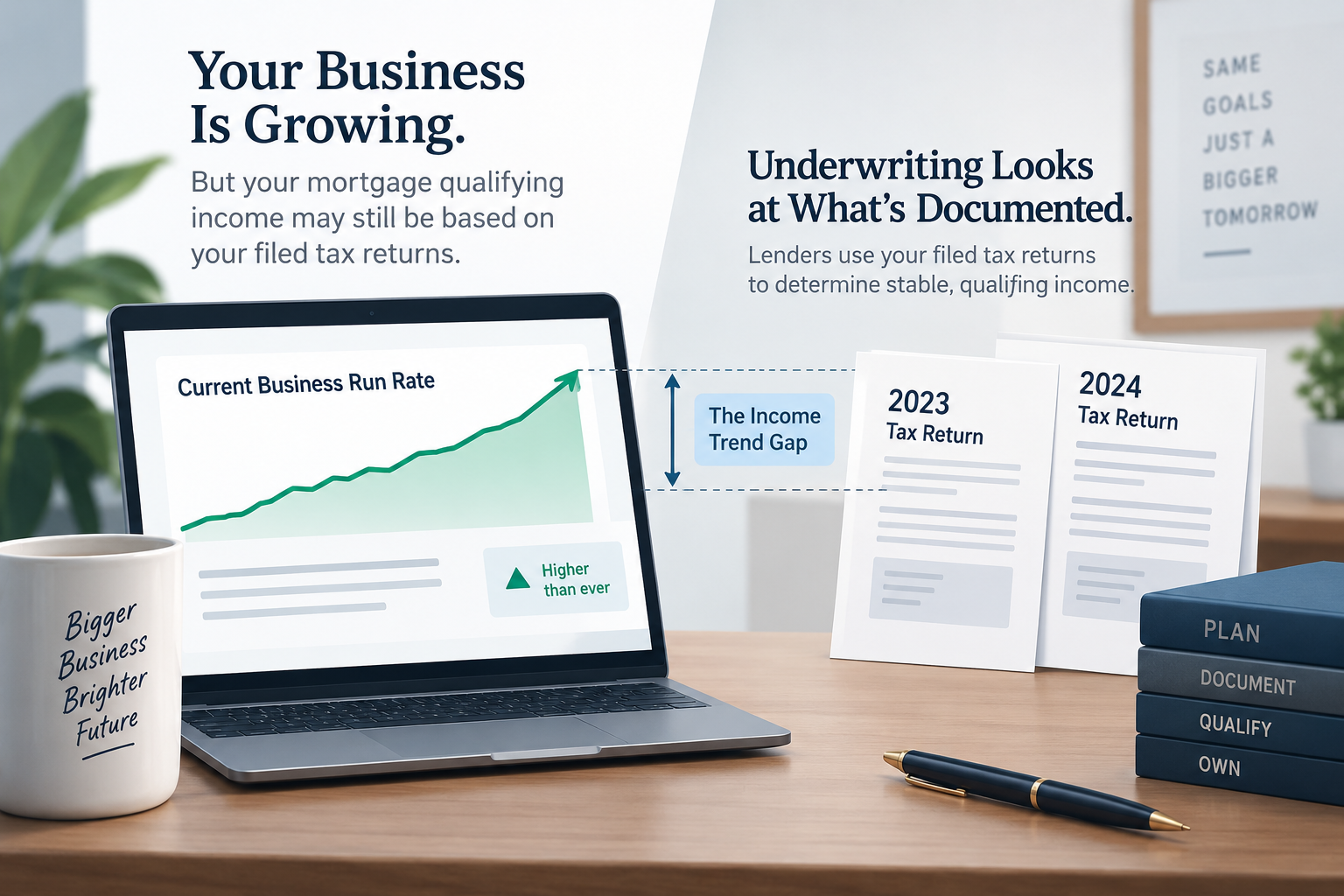
Your business finally clicked.
Two years ago, you made $55,000. Last year, $72,000. This year, you’re on pace for $90,000 or more.
Then a mortgage lender looks at your file and qualifies you using a number that feels like it belongs to the old version of your business.
That can be frustrating, but there is a reason for it.
A mortgage lender is not simply trying to estimate what you’re earning right now. It is trying to determine how much documented, stable income can reasonably be relied upon to support a mortgage over time.
Those are two different questions.
Your current run rate answers:
“What is my business earning today?”
Underwriting asks:
“How much income can we actually document and support for mortgage qualification?”
That difference is where many self-employed borrowers get surprised.
The Short Answer: Your Business Can Grow Faster Than Your Mortgage Income
Higher freelance income can absolutely strengthen your financial position.
But a strong current year does not automatically become the income a lender uses to qualify you.
Self-employed mortgage income is generally based on documented business performance, tax-return history and the underwriting methodology that applies to your loan.
A few excellent months may be real.
They just may not yet carry the same weight as a longer documented trend.
That creates a gap between what your business is earning now and what underwriting can currently support.
We call that the EarnerLedger Income Trend Gap.
A simple illustration of why the income you are earning now can be higher than the amount currently supported for mortgage qualification.
Revenue, Profit and Mortgage Qualifying Income Are Not the Same Number
This distinction matters more than almost anything else in self-employed mortgage underwriting.
| Term | What it means |
|---|---|
| Gross revenue | Total money the business receives before expenses |
| Business expenses | Costs incurred to operate the business |
| Business profit | Revenue remaining after business expenses |
| Tax-return income | Income reflected on the applicable tax forms after deductions and accounting treatment |
| Mortgage qualifying income | Income the lender determines can be used after applying the relevant underwriting analysis and adjustments |
Imagine your business generates:
Gross revenue: $150,000
Business expenses: $70,000
Profit: $80,000
The $150,000 headline sounds impressive.
But it does not mean you have $150,000 of income available to support a mortgage.
Even the $80,000 profit figure is not automatically the lender’s final qualifying-income number. Depending on your business structure and tax return, underwriting may make specific adjustments when determining usable cash flow.
Revenue ≠ profit ≠ mortgage qualifying income.
If you want the broader picture of how lenders evaluate self-employed borrowers, read our complete guide to self-employed mortgage requirements.
Why Mortgage Lenders Look Backward When Your Business Is Moving Forward
A business owner naturally focuses on what is happening now.
Mortgage underwriting has to care about what can be documented.
That’s the tension.
If your business made:
- $50,000 two years ago
- $70,000 last year
- and is now running at $100,000 annually
you may reasonably think:
“I make $100,000 now.”
The lender has a different problem.
It needs to decide how much of that recent increase is sufficiently established to rely upon for a long-term mortgage obligation.
A record month may be great news for your bank account.
It is not automatically a new mortgage-income baseline.
The lender may examine income stability, the financial strength of the business, recurring income and expenses, and whether the business appears capable of continuing to generate sufficient earnings.
The goal is not to punish growth.
It is to distinguish sustained growth from a temporary spike.
Recent growth can happen quickly, while the documentation used to support mortgage income often reflects a slower, historical record of the business.
What Fannie Mae Looks at in a Self-Employed Business
Fannie Mae’s guidance requires lenders to analyze self-employment income rather than simply accept a business owner’s headline revenue.
The analysis can include factors such as:
- stability of the borrower’s income;
- the nature of the business;
- demand for its products or services;
- financial strength of the business;
- recurring income and expenses;
- trends in gross income;
- trends in expenses;
- trends in taxable income;
- the business’s ability to continue generating sufficient income.
This is why two businesses with the same current monthly revenue can result in very different mortgage calculations.
One may have years of consistent profitability.
The other may have experienced one unusually strong quarter.
On a spreadsheet showing only today’s revenue, they can look similar.
From an underwriting perspective, they are not.
Do Mortgage Lenders Always Average Two Years of Self-Employed Income?
No.
“Mortgage lenders average your last two years” is a useful shortcut, but it is too simplistic to treat as a universal rule.
Historical income often matters heavily for self-employed borrowers, but underwriting also considers the direction and stability of that income.
A business showing a coherent upward trend is not identical to one whose income is declining.
Likewise, a business with two years of volatile results does not suddenly become predictable because someone calculated an average.
The exact treatment depends on factors including:
- loan program;
- business structure;
- tax documentation;
- income trend;
- underwriting findings;
- lender requirements.
So calculating a simple two-year average may give you a useful rough reference.
It should not be treated as a guaranteed mortgage qualifying-income formula.
The EarnerLedger Income Trend Gap
Here’s a useful way to understand the problem.
Current Business Run Rate
What your business appears to be earning now.
versus
Documented Mortgage Qualifying Income
What underwriting can currently support using acceptable documentation and the applicable methodology.
We call the difference the Income Trend Gap.
Current Business Run Rate − Documented Mortgage Qualifying Income = Income Trend Gap
This is an EarnerLedger educational framework, not an official Fannie Mae, FHA or lender formula.
Consider a purely hypothetical example.
Your business is currently running at:
$8,500 per month
But based on the documented historical income being used in the hypothetical calculation, the supported income comes out closer to:
$6,400 per month
That creates an illustrative:
$2,100 monthly Income Trend Gap
The important lesson isn’t the $2,100.
It’s why the gap exists.
Your business changed faster than your documented mortgage history did.
As more strong performance becomes part of your established financial record, that gap may change.
Four Ways Rising Income Can Look to a Mortgage Lender
| Scenario | Historical income | Current situation | Main issue |
|---|---|---|---|
| Steady growth | $55k → $72k | ~$90k run rate | Growing trend with history |
| Sudden breakout | $45k → $50k | ~$100k recent run rate | Growth is extremely recent |
| Multi-year growth | $60k → $75k → $90k | Stable or slightly higher | Longer evidence of growth |
| Revenue up, profit down | $150k → $190k revenue | Profit falls $80k → $70k | Business got bigger but less profitable |
Scenario 1: Steady Growth
Suppose your documented income rises from $55,000 to $72,000 and the current business is now running closer to $90,000 annually.
That’s a cleaner story than a sudden explosion in income because some of the growth already exists in the documented history.
But that does not automatically mean the lender simply uses $90,000.
The current run rate and qualifying income remain separate concepts.
Scenario 2: The Business Suddenly Takes Off
Year 1: $45,000
Year 2: $50,000
Last four months: pace equivalent to roughly $100,000 annually
The business may genuinely have transformed.
Maybe you raised prices. Maybe referrals exploded. Maybe you landed a huge contract.
But four months is still four months.
Underwriting generally needs enough evidence to support the idea that higher income is stable rather than temporary.
A recent spike can improve the story.
It doesn’t automatically rewrite the two years that came before it.
Scenario 3: Multi-Year Consistent Growth
Year 1: $60,000
Year 2: $75,000
Latest documented year: $90,000
Current performance: approximately the same or slightly stronger
This looks fundamentally different from Scenario 2.
There is no single breakthrough month carrying the entire story.
The trend itself has become part of the documented history.
That’s generally a more coherent income pattern for underwriting to evaluate.
Scenario 4: Revenue Goes Up — Profit Goes Down
Year 1
Revenue: $150,000
Expenses: $70,000
Profit: $80,000
Year 2
Revenue: $190,000
Expenses: $120,000
Profit: $70,000
Revenue increased by $40,000.
Expenses increased by $50,000.
Profit fell by $10,000.
The business got bigger.
The underlying profit got smaller.
That is why saying “my business grew 27%” does not necessarily mean “my mortgage income increased 27%.”
For underwriting purposes, the economics beneath the revenue headline matter.
What Can a Year-to-Date Profit and Loss Statement Actually Do?
A current profit and loss statement can be useful because it gives the lender a more recent picture of how the business is performing.
It may help support an assessment of whether documented income remains stable or appears likely to continue.
But there’s an important distinction:
A P&L can provide evidence about the current business. It does not automatically replace your filed tax-return history.
If last year’s tax return reflects a weaker version of the business and this year is considerably stronger, a current P&L can help explain what has changed.
That doesn’t mean the lender can simply substitute the newest annualized number for the documented history.
Think of a P&L as supporting evidence.
Not a magic reset button.
What If One Huge New Client Caused the Income Increase?
Suppose your existing clients generate $6,000 per month.
Then you sign one new client worth another $4,000 per month.
Suddenly you’re at $10,000 per month.
The new income is real.
But there are still reasonable questions around it.
How new is the relationship?
A contract signed last month has less history than one that has existed for several years.
How concentrated is your income?
One client now represents 40% of your monthly revenue.
Losing that client would materially change the business.
Is the work recurring?
A $48,000 one-year project and a continuing client relationship are economically different even if they initially pay the same amount.
Is it documented?
Contracts, invoices and consistent payments create a clearer financial story than an informal expectation that the client will continue indefinitely.
This does not mean Fannie Mae automatically discounts income from new clients.
There is no universal rule that says a new client automatically does not count.
The point is simpler.
Recent growth needs enough evidence to look sustainable.
What If Revenue Is Growing but Expenses Are Growing Faster?
This deserves repeating because it’s one of the easiest mistakes to make.
A business can grow rapidly while simultaneously becoming less profitable.
Imagine revenue increases 27%.
That sounds excellent.
But if expenses increase even faster, the amount actually available to the owner can decline.
A million-dollar business with $980,000 of expenses is not producing the same borrower income as a $300,000 business with $100,000 of expenses.
The size of the business is not the same thing as the amount of income available to support a mortgage.
What If Your Self-Employment Income Is Declining?
Declining income creates a different problem.
Now the lender isn’t deciding how much recent growth it can comfortably recognize.
It’s deciding whether historical income remains a reliable indicator of what the business will produce going forward.
That distinction matters.
A historical average can potentially overstate the economic reality of a business that is deteriorating.
That’s one reason income trends matter rather than simply treating every historical year equally.
Different loan programs can apply different rules to declining self-employment income, so an FHA treatment should not automatically be assumed to apply to a conventional mortgage, or vice versa.
The underlying principle remains:
The lender is trying to identify income that appears sustainable, not simply the highest historical number available.
Can More Savings or a Bigger Down Payment Close the Income Trend Gap?
Not directly.
A larger down payment can improve the overall structure of a mortgage application.
Strong reserves can also be valuable.
But neither changes the basic question:
How much qualifying income can be documented?
Putting another $30,000 into savings does not automatically cause the lender to recognize higher recent income.
Assets and income are different parts of the mortgage file.
Strong assets can make the overall application stronger.
They don’t transform unsupported income into documented qualifying income.
Would Waiting for Another Tax Return Help?
Has the documentation caught up?
Sometimes.
Suppose your business changed dramatically this year.
Your latest filed return still reflects $55,000.
But the business is now consistently producing something much closer to $85,000.
Another completed tax year could eventually document more of that stronger performance.
Waiting may therefore improve the income story when:
- recent growth is genuinely new;
- profitability has improved materially;
- current performance has become consistent;
- your latest return reflects an older version of the business;
- another documented year would establish a clearer trend.
But waiting isn’t automatically the correct decision.
Mortgage rates may change.
Home prices may move.
Your business may improve further or weaken.
Your personal plans may change.
The useful question isn’t “Should every self-employed borrower wait?”
It’s:
“Would additional documented history materially change the income my lender can support?”
That’s a much better conversation to have with a lender.
How to Make Rising Income Easier to Understand During Underwriting
You cannot control every underwriting decision.
You can make your financial story easier to verify.
Keep your bookkeeping current
Don’t wait until mortgage underwriting to reconstruct nine months of business activity.
Keep business and personal finances clearly organized
Cleaner records make it easier to understand where money is coming from and where it is going.
File complete tax returns
Tax documentation remains central to self-employed income analysis.
Maintain current financial records
If the business has changed materially since the last tax return, current records can help explain what happened.
Document unusual events
Maybe you lost a client last year.
Maybe you invested heavily in equipment.
Maybe a one-time expense temporarily reduced profit.
An unexplained number invites questions.
A documented event is much easier to understand.
Avoid contradictions
If your tax return, P&L, bank activity and verbal explanation all appear to tell different stories, underwriting becomes harder.
Good documentation doesn’t create income.
It makes real income easier to evaluate.
The Bigger Lesson: Your Business and Your Mortgage File Move at Different Speeds
Entrepreneurs tend to live in the present.
You know how many clients came in this month.
You know what your pipeline looks like.
You know that the last six months were completely different from the previous year.
Mortgage underwriting operates with more friction.
It needs documentation.
It needs history.
It needs a defensible income figure.
That’s why a business can improve much faster than the mortgage file associated with it.
The frustrating part isn’t necessarily that the lender thinks you’re earning less.
It’s that the lender may not yet have enough documented evidence to treat today’s stronger business as tomorrow’s reliable income.
The Bottom Line
Making more money absolutely matters.
But what your business is earning today and what a mortgage lender can currently use as qualifying income are not necessarily the same number.
Recent growth may strengthen the story.
A current P&L may provide useful context.
A longer upward trend may make the growth more convincing.
But gross revenue, current monthly deposits and a recent annualized run rate are not automatically mortgage qualifying income.
For self-employed borrowers, the strongest income story is usually one that is profitable, documented, consistent, understandable, supportable and likely to continue.
Your business can improve faster than your mortgage file does.
Understanding that gap before you apply can save you from finding it out halfway through underwriting.
This article is for general educational purposes only and is not mortgage, financial, tax or legal advice. Mortgage eligibility and qualifying income depend on the loan program, applicable underwriting guidelines, lender requirements and the borrower’s complete financial profile.
Frequently Asked Questions
Do mortgage lenders average two years of self-employed income?
Historical averaging is common, but it is too simplistic to assume every lender or loan program always uses the same two-year formula. Income trends, documentation, business structure and the applicable underwriting guidelines can affect the final calculation.
Can a mortgage lender use my higher income from this year?
Current-year information can help demonstrate how the business is performing now, but recent higher income does not automatically replace the documented history used to calculate qualifying income.
Can a profit and loss statement increase my mortgage qualifying income?
A P&L can help document current business performance and support an analysis of income stability or continuance. It should not be assumed to automatically replace filed tax returns or cause a lender to adopt your current annualized income.
Does rising self-employed income help a mortgage application?
It can. A sustained upward trend generally provides a stronger income story than a declining business. However, recent growth still needs sufficient documentation and does not automatically become the qualifying-income figure.
What if my freelance income doubled this year?
A large recent increase can strengthen your financial position, but a short period of unusually high income may not provide enough history by itself to establish a new sustainable mortgage-income baseline.
Do mortgage lenders use gross revenue or net income?
Lenders do not simply use gross business revenue. Self-employed qualifying income is generally determined using tax documentation, business income and expenses, and applicable underwriting adjustments.
Does a new freelance client count as mortgage income?
A new client can contribute to your actual business income, but how that recent income affects mortgage qualification depends on the documentation, income history, loan program and underwriting analysis.
Can I qualify based only on what I’m earning this month?
Generally, current monthly business income alone is not enough to determine self-employed mortgage qualifying income. Underwriting typically relies on a broader documented history.
Why is my mortgage qualifying income lower than what I earn now?
Your current earnings may reflect recent growth, gross revenue or a short strong period, while qualifying income is based on documented business history and the underwriting methodology applicable to your mortgage.
Would waiting for another tax return help?
Potentially. If your business has recently become substantially more profitable, another completed tax year may provide additional evidence of that stronger income. Whether waiting makes sense depends on your individual circumstances.