
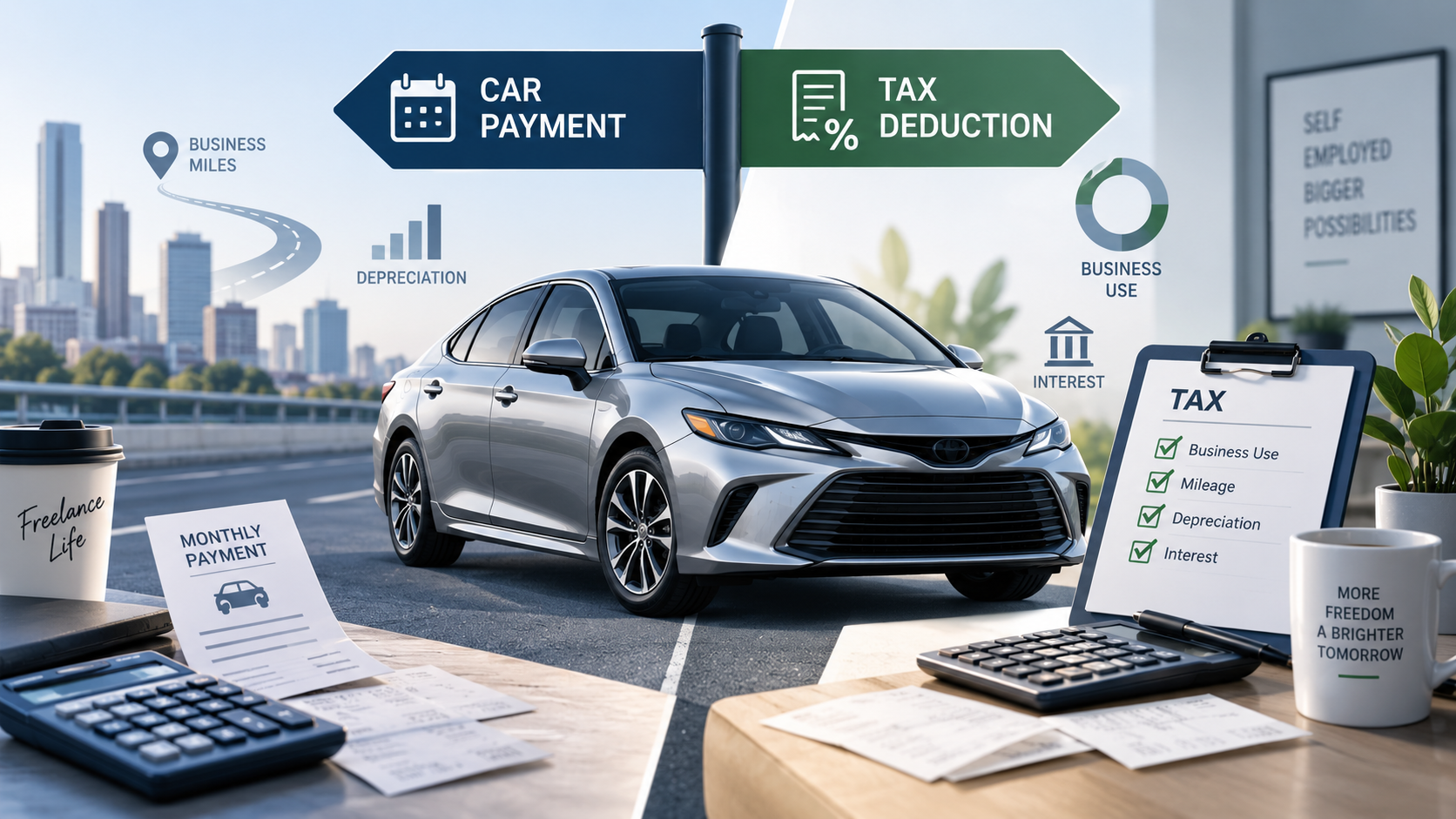
No — you generally can’t write off your monthly car payment itself, even if you use the car entirely for work. That surprises a lot of freelancers, because people almost universally confuse “car payment” with “car deduction.” What you can actually deduct depends on which method you use: either a standard rate per business mile driven, or a set of actual vehicle costs. Either way, the loan payment itself breaks down into a non-deductible principal portion and a potentially deductible interest portion — not one deductible lump sum.
Can You Write Off Your Car Payment If You’re Self-Employed?
Not directly, and not as a flat monthly deduction. A car payment is really two different things bundled into one number: principal (repaying the amount you borrowed) and interest (the cost of borrowing it). Either method available to freelancers treats the principal portion as non-deductible. Instead, the cost of the vehicle itself gets recovered over time through depreciation. The interest portion can potentially count as a deduction, but only under the actual expense method, and only for the percentage of the vehicle’s use that’s genuinely business-related.
The Key Difference: Car Payment vs. Car Deduction
Three separate concepts get conflated constantly in this topic, and keeping them apart is the foundation for everything else in this article.
Principal is simply repaying money you borrowed to buy the car. It was never income to begin with, so it isn’t an expense in the tax sense — you’re just returning capital.
Interest is the actual cost of borrowing. This is a genuine expense, and it can be deductible for the business-use portion of the vehicle, but only under the actual expense method.
Depreciation is how the tax code recognizes that a vehicle loses value over time, regardless of how you paid for it — cash, loan, or otherwise. Depreciation stays separate from your loan payment entirely and follows its own set of rules and limits.
Two Ways Freelancers Can Deduct Vehicle Expenses
Standard Mileage Rate
The standard mileage rate uses a flat rate per business mile driven, set by the IRS and adjusted periodically. For 2026, that’s 72.5 cents per mile for miles driven January 1 through June 30, and 76 cents per mile for miles driven July 1 through December 31, following a mid-year increase. A single rate covers gas, maintenance, insurance, registration, and depreciation combined. Because depreciation is already built into the rate, you can’t separately deduct depreciation on top of it — that would be double-counting the same cost.
Actual Expense Method
The actual expense method totals your real vehicle costs for the year — gas, insurance, repairs, maintenance, tires, registration, and depreciation — then applies your business-use percentage to the total. Loan interest, specifically the business-use portion of it, is also deductible under this method, unlike under standard mileage.
Example: $35,000 Car With a $650 Monthly Payment
Say a freelancer buys a $35,000 vehicle, finances it with a $650 monthly payment, and uses it 70% for business.
It’s tempting to calculate $650 × 12 × 70% and treat that as the deduction. That’s not how this works. That $650 bundles together both principal and interest, and only the interest portion — at the 70% business-use rate — potentially qualifies as a deduction, and only under the actual expense method. The principal portion of every payment isn’t deductible at all, regardless of method. The interest-versus-principal split changes every month as the loan amortizes, and it comes from the loan’s own amortization schedule, not from the payment amount itself. A lender’s statement or amortization table shows the actual monthly interest figure.
Separately, the vehicle’s cost basis attributable to business use — 70% of $35,000, or $24,500 — becomes the starting point for a depreciation calculation under the actual expense method, subject to the passenger vehicle limits covered below. None of this applies under the standard mileage method: the deduction simply multiplies business miles driven by the applicable rate for when those miles were driven, with no reference to the loan or its payment structure.
Standard mileage vs. actual expenses, conceptually: standard mileage sidesteps the entire loan-payment question by working off miles instead of costs. Actual expenses engages the loan (interest, not principal) and the vehicle’s depreciation directly, but requires tracking real costs throughout the year rather than just a mileage log. Neither method wins by default — it depends on the specific vehicle, financing terms, and how many miles get driven.
Can You Deduct Car Loan Interest?
Only under the actual expense method, and only the business-use percentage of it. If a freelancer’s total loan interest for the year comes to $1,800 and the vehicle sees 70% business use, $1,260 of that interest is potentially deductible. This is entirely separate from principal, which is never deductible as a standalone expense under either method.
Can You Deduct Depreciation on a Financed Car?
Yes, under the actual expense method — financing the vehicle doesn’t change your ability to claim depreciation, since depreciation is based on the vehicle’s cost and business use, not on how it was paid for. What does change the numbers significantly is whether the vehicle qualifies for standard passenger-vehicle depreciation limits or falls into the heavier-vehicle category with a much higher cap.
For a passenger vehicle (generally 6,000 lbs GVWR or less) placed in service in 2026, the IRS limits first-year depreciation regardless of the vehicle’s actual price. Sources commonly cite a figure in the neighborhood of $20,200 to $20,400 when 100% bonus depreciation applies, though even authoritative sources show slightly different exact numbers this year. Confirm the precise current-year figure against the IRS’s own guidance before filing. Your business-use percentage then reduces that cap further — a freelancer using a passenger car 70% for business sees that first-year limit shrink to roughly 70% of whatever the applicable cap turns out to be, not the full amount.
Vehicles rated between 6,001 and 14,000 pounds GVWR — many larger SUVs and trucks — follow a different, much less restrictive rule: a separate Section 179 cap of $32,000 for 2026, with any remaining cost potentially eligible for 100% bonus depreciation on top of that, since the One Big Beautiful Bill Act permanently restored the 100% bonus depreciation rate for qualifying property placed in service after January 19, 2025.
What If You Bought the Car With Cash?
The same two methods still apply, minus the interest question entirely — there’s no loan interest to deduct if there’s no loan. Standard mileage works identically regardless of financing. Under actual expenses, depreciation still applies the same way, subject to the same passenger-vehicle or heavier-vehicle limits described above. Depreciation is based on the vehicle’s cost and business use, not on whether you paid cash or financed it.
What If You Lease Your Car?
Leasing changes the mechanics under actual expenses: instead of depreciation, you generally deduct the business-use percentage of your actual lease payments. The IRS also requires a separate “inclusion amount” adjustment for certain higher-value leased vehicles, designed to prevent leasing from sidestepping the same luxury-vehicle limits that apply to owned cars. Standard mileage remains available for leased vehicles too, with one restriction: choose standard mileage for a leased vehicle, and you generally must use it for the entire lease term, including any renewal period, rather than switching methods partway through.
What If You Use the Car for Both Business and Personal Driving?
This is the normal situation for most freelancers. A business-use percentage handles it:
Business-use percentage = Business miles ÷ Total miles
If a freelancer drives 18,000 miles in a year and 12,600 of those are for genuine business purposes, that’s a 70% business-use percentage (12,600 ÷ 18,000). That percentage then applies to actual expenses. Under the standard mileage method, that same percentage instead determines which miles count at all — only the business miles get the rate applied to them, never the personal ones.
What If the Car Is in Your Personal Name?
Vehicle ownership on paper doesn’t determine deductibility — business use does. A freelancer operating as a sole proprietor commonly uses a personally titled vehicle for business purposes. They deduct the business-use portion under either method, with no requirement to retitle the car in a business name.
What If the Car Is Owned by Your LLC?
Having an LLC doesn’t automatically make vehicle costs more deductible, and it doesn’t change either method’s underlying rules. The same business-use percentage requirement, the same distinction between principal and interest, and the same depreciation limits all still apply. What an LLC does change is administrative: if the LLC itself owns and finances the vehicle, the loan and title are in the business’s name rather than the owner’s personal name, which can affect recordkeeping and, in some cases, insurance and liability considerations — but it doesn’t unlock a bigger deduction just by virtue of the LLC structure.
What Expenses Can Freelancers Deduct?
| Expense | Standard Mileage | Actual Expenses |
|---|---|---|
| Gas | Built into the per-mile rate | Deductible at your business-use % |
| Insurance | Built into the per-mile rate | Deductible at your business-use % |
| Repairs | Covered by the per-mile rate | Deductible at your business-use % |
| Maintenance | Covered by the per-mile rate | Deductible at your business-use % |
| Tires | Rolled into the per-mile rate | Deductible at your business-use % |
| Depreciation | Built into the rate — not separately deductible | Deductible at your business-use %, subject to limits |
| Car loan interest | Not deductible | Deductible at your business-use % |
| Registration | Rolled into the per-mile rate | Deductible at your business-use % |
| Parking (business-related) | Separately deductible under either method | Separately deductible |
| Tolls (business-related) | Separately deductible under either method | Separately deductible |
| Personal-use portion of any cost | Never deductible | Never deductible |
| Principal loan payment | Never deductible | Never deductible |
Standard Mileage vs. Actual Expenses: Which Is Better?
Neither method wins universally — it depends on your specific vehicle and situation. Standard mileage tends to favor freelancers with lower-cost, fuel-efficient vehicles and simpler recordkeeping needs, since it only requires a mileage log rather than tracking every individual cost. Actual expenses tends to favor freelancers with a more expensive vehicle, significant loan interest, or high repair or insurance costs. It also favors a heavier vehicle that qualifies for the more generous Section 179 and bonus depreciation treatment described above. Running the numbers both ways for your specific vehicle and mileage is the only way to know which produces a larger deduction in your situation.
One rule worth knowing before you decide: using the standard mileage rate in the first year a vehicle is used for business generally preserves your flexibility to switch to actual expenses in a later year. Starting with actual expenses and claiming certain depreciation methods in year one, however, can lock you into actual expenses for that vehicle going forward. Choose your first-year method with this in mind, rather than defaulting to whichever seems simpler that year.
What Records Should You Keep?
- A mileage log recording date, business purpose, and miles driven for each trip
- Total annual mileage, both business and personal, to calculate your business-use percentage
- Receipts for gas, repairs, maintenance, and other actual expenses if using that method
- Loan interest statements from your lender showing the interest portion of your payments
- Insurance and registration documentation
- Purchase or lease documents establishing the vehicle’s cost and acquisition date
Common Mistakes Freelancers Make
- Deducting the full monthly car payment, rather than separating interest from principal and applying the business-use percentage correctly.
- Deducting both mileage and depreciation for the same vehicle in the same year — the standard mileage rate already includes depreciation.
- Claiming 100% business use without supporting evidence, when most freelancers who also use a vehicle personally have some genuine personal-use percentage.
- Deducting ordinary commuting as if it were business mileage — commuting between home and a regular place of business generally isn’t deductible business mileage.
- Not maintaining a mileage log, leaving no support for the business-use percentage claimed.
- Mixing personal and business expenses without separating them clearly in records.
- Assuming an LLC changes the underlying deduction rules for vehicle expenses, when it generally doesn’t.
Frequently Asked Questions
Can I write off my entire car payment? No. The principal portion is never deductible under either method; only the interest portion, at your business-use percentage, is potentially deductible under the actual expense method.
Does being a 1099 worker change how I deduct my car? No. You still use either the standard mileage rate or the actual expense method, based on the business-use percentage of your driving.
What happens if I write off a financed car? Financing doesn’t change your ability to deduct vehicle costs. You can still use either method; the loan simply introduces an interest component that’s deductible under actual expenses specifically.
Is car loan interest deductible? Only under the actual expense method, and only the business-use percentage of the interest — not the principal, and not under the standard mileage method.
Should I deduct gas and mileage together? No. Gas is only separately deductible under the actual expense method; under standard mileage, gas is already built into the per-mile rate.
Do Uber drivers get to deduct their car payments? Not the payment itself. The same principal-versus-interest and standard-mileage-versus-actual-expenses rules apply to rideshare and delivery drivers the same way they apply to any other self-employed vehicle use.
What about DoorDash drivers specifically? Same answer — the full payment isn’t deductible, but the business-use portion of loan interest (under actual expenses) or business mileage (under standard mileage) generally is.
Can I still deduct my car if it’s in my personal name? Yes. Vehicle ownership on paper doesn’t determine deductibility — genuine business use does.
Does my car need to be owned by my LLC? No. An LLC doesn’t change the underlying deduction rules, and a personally titled vehicle used for business remains deductible under the same rules either way.
Bottom Line
A car payment and a car deduction aren’t the same thing. Treating them as interchangeable is the single most common mistake freelancers make with vehicle expenses. Principal is never deductible. Interest can be, but only under the actual expense method and only at your business-use percentage. Depreciation follows its own set of rules and limits, separate from the loan entirely, and gets replaced altogether by a flat per-mile rate if you choose standard mileage instead. Running both methods against your actual numbers — not guessing based on your monthly payment — is the only reliable way to know what you can actually deduct.
This article is for general educational purposes and reflects federal tax guidance in effect for the 2026 tax year at the time of writing. It is not individualized tax advice. Consult a CPA, enrolled agent, or other qualified tax professional for guidance specific to your situation.
Sources
- IRS Publication 463, Travel, Gift, and Car Expenses — standard mileage vs. actual expense method rules, recordkeeping requirements, and the method-switching rule
- IRS — 2026 standard mileage rate announcements (Notice 2026-10; Announcement 2026-11, mid-year increase effective July 1, 2026)
- IRS Section 280F — passenger automobile depreciation limits (“luxury auto” limits)
- IRS Section 179 — vehicle expensing rules, including the separate limitation for sport utility vehicles and other passenger-type vehicles between 6,001 and 14,000 pounds GVWR
- One Big Beautiful Bill Act — permanent restoration of 100% bonus depreciation for qualifying property acquired after January 19, 2025