
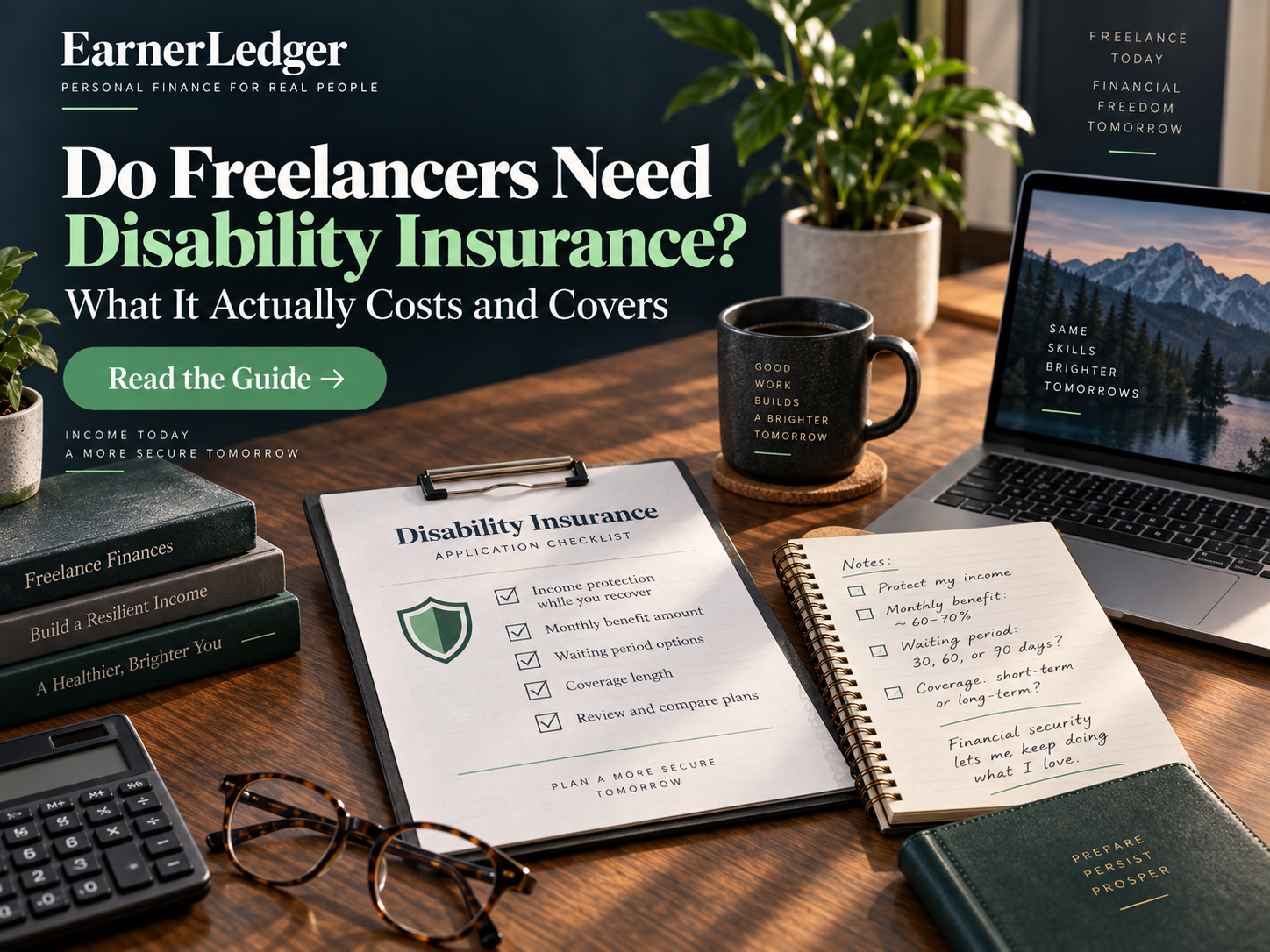
Freelancers aren’t legally required to buy private disability insurance simply because they’re self-employed. But losing the ability to work can be financially severe precisely because there’s usually no employer disability benefit sitting underneath you. What matters most in deciding: how dependent you are on your own earned income, whether anyone else relies on that income, and how much you have in emergency savings. Also worth weighing: your fixed monthly expenses, your occupation, any other income sources in your household, and whether you already have coverage through a spouse’s plan or a prior employer.
What Disability Insurance Does for a Freelancer
Say a self-employed graphic designer earns $6,000 a month and can’t work for six months after a serious injury.Without coverage, that entire $6,000 monthly income disappears for the duration. Rent, insurance premiums, loan payments, and other fixed costs keep arriving on schedule regardless. A disability insurance policy is built to replace a portion of that lost income, generally somewhere between 50% and 70% depending on the policy, for as long as the benefit period lasts. It doesn’t pay medical bills and it doesn’t replace 100% of income — it’s specifically designed to keep essential expenses covered while you’re unable to earn.
Why Disability Insurance Matters More When You’re Self-Employed
A W-2 employee often has a safety net most freelancers don’t: employer-sponsored short-term disability, sometimes long-term disability, and in many cases paid sick leave that covers at least the first stretch of a health event. None of that exists by default for a self-employed worker. There’s no HR department automatically enrolling you in coverage, and there’s no continued paycheck if you stop working.
Health insurance doesn’t fill this gap either — it’s worth being direct about that, since people commonly confuse the two. Health insurance pays for treatment. It says nothing about the income you’re not earning while you’re getting that treatment. A freelancer can have excellent health coverage and still face a genuine income crisis during a long recovery.
Short-Term vs. Long-Term Disability Insurance
| Feature | Short-Term | Long-Term |
|---|---|---|
| Waiting period (elimination period) | Often 0–14 days | Commonly 90–180 days |
| Benefit duration | Typically a few months up to about a year | Commonly several years, or in some policies to retirement age |
| Typical purpose | Bridging a shorter recovery — surgery, injury, pregnancy-related leave | Protecting against an extended or permanent inability to work |
| Common availability | More common as an employer group benefit than as an individual policy | Widely available as an individual policy for self-employed buyers |
| Cost consideration | Generally lower premium given the shorter potential payout | Generally higher premium, offset somewhat by choosing a longer elimination period |
Not every insurer structures both types identically — these are general patterns, not a universal policy template. Many freelancers end up relying primarily on a long-term policy paired with an emergency fund to cover the shorter gap a short-term policy would otherwise address.
How Much Income Does Disability Insurance Replace?
Insurers generally cap coverage well below 100% of income — commonly in the 50% to 70% range, sometimes lower for higher earners. This isn’t arbitrary: insurers structure it this way partly to preserve an incentive to return to work when medically able, and partly because the underwriting math works differently at full income replacement. The exact percentage varies by carrier and by how each insurer defines and documents income, so treat any specific number as a starting range to confirm with an actual quote, not a fixed industry standard.
How Much Disability Insurance Does a Freelancer Need?
Rather than defaulting to the maximum available coverage, work from your actual essential expenses — the number that has to be covered regardless of what else is happening, not your full current spending. Compare that figure to what a policy replacing 50-70% of income would realistically pay out each month. Layer in how many months your emergency fund could bridge on its own, whether a spouse or partner’s income covers part of the gap, and whether any other income sources (passive income, a part-time role, savings) reduce your actual exposure.
Worked Example
A self-employed consultant earns roughly $90,000 a year in gross income, with essential monthly expenses of about $4,000 and a three-month emergency fund. They have no employer disability benefits and no other household income.
Their emergency fund covers three months on its own. Beyond that point, without any income replacement, they’d need to cover $4,000 a month from savings that no longer exist, or from a source they haven’t identified. A policy with a 90-day elimination period would let the emergency fund bridge the waiting period. Monthly benefits would begin right around when that fund would otherwise run dry — timing the coverage to start where the safety net ends, rather than paying for a shorter elimination period that overlaps with savings they already have. This is a decision-support illustration, not individualized insurance advice; an actual policy quote would depend on their specific health, occupation, and the insurer’s own underwriting.
What Does Disability Insurance Cost for Freelancers?
Premiums vary enough between individuals that a single universal number would be misleading. What genuinely moves the price: age, health history, occupation and its associated risk level, the monthly benefit amount you select, the elimination period, the benefit period, any additional riders, and smoking status. Two freelancers earning the same income can pay meaningfully different premiums if one works a physically demanding job and the other works entirely at a desk, or if one selects a 30-day elimination period and the other selects 180 days. Getting an actual quote from a licensed agent, rather than relying on a general published range, is the only way to know your real cost.
Is Disability Insurance Tax Deductible for Self-Employed Workers?
This is where a lot of otherwise-good content gets it wrong, and the honest answer depends on your business structure — it isn’t a simple universal yes or no.
| Who Pays the Premium | Premium Deductible? | Benefits Taxable? | Typical Context |
|---|---|---|---|
| Sole proprietor or partner, personal policy | No | No — benefits generally received tax-free | The most common situation for independent freelancers |
| C corporation, on behalf of an employee (including an owner-employee) | Yes, as a business expense | Yes — benefits are generally taxable | Requires operating as a C corp, uncommon for solo freelancers |
| S corporation, on behalf of a shareholder-employee owning more than 2% | Yes, but the premium must be added to the shareholder’s W-2 wages | No — because the premium was already taxed as income, benefits are generally received tax-free | Applies specifically to S corp owners above the 2% ownership threshold |
| Business overhead expense (BOE) policy, any structure | Yes, as a business expense | Benefits are generally taxable | A different product entirely — see below |
The common assumption — “I’m self-employed, so this must be a deductible business expense” — is often wrong for the most typical case: a sole proprietor or partner buying a personal disability income policy to protect their own earnings. The IRS has addressed this specifically; premiums for that kind of policy generally aren’t deductible, and the tradeoff is that the eventual benefits come out tax-free.
Why Paying Premiums Personally Can Affect Whether Benefits Are Taxable
Deductibility of the premium and taxability of the benefit are two separate questions, and they move in opposite directions from each other. If you pay premiums with money that was never deducted or excluded from your taxable income — the standard situation for a sole proprietor’s personal policy — the resulting benefit is generally tax-free. You’ve effectively already paid tax on the money used to fund the coverage.
If premiums get paid in a way that reduces taxable income upfront — a C corporation paying on behalf of a regular employee, for instance — the benefit generally becomes taxable when received. That’s because it wasn’t taxed on the way in. The S corporation 2% shareholder rule sits in between structurally: the corporation deducts the premium, but the shareholder still picks up that amount as W-2 wages, meaning it was taxed to the individual. The eventual benefit still comes out tax-free, consistent with the general principle.
Own-Occupation vs. Any-Occupation Coverage
This distinction matters more for some freelancers than others. An own-occupation definition pays a benefit if you can’t perform the specific duties of your own occupation, even if you could technically work in a different field. An any-occupation definition only pays if you can’t perform any occupation reasonably suited to your education and experience — a much higher bar to meet.
Consider a surgeon who develops a hand tremor: under an own-occupation policy, they could likely still collect benefits even if they could theoretically work in a non-surgical medical role, because they can no longer perform surgery specifically. Under an any-occupation policy, they might not qualify, since some other suitable work remains available to them. For a freelance consultant or designer whose income depends heavily on a specific skill set, the same logic applies, though the practical stakes are often less dramatic than the surgeon example. Some policies offer a “modified own-occupation” definition that sits between the two. Policy language varies meaningfully between insurers, so this is worth reading closely rather than assuming.
What Is an Elimination Period?
The elimination period is the waiting time between when a disability begins and when benefit payments actually start — commonly offered at 30, 90, or 180 days, though not every insurer offers every option. A longer elimination period generally lowers your premium, on the logic that you’re expected to cover that initial stretch yourself. This is exactly where an emergency fund does real work: the stronger your savings cushion, the more comfortably you can select a longer elimination period and pay less for the same eventual coverage.
How Long Should Benefits Last?
Benefit periods commonly range from two years, to five years, to an “own-age” duration extending to retirement age (often stated as 65 or 67, though this varies by policy). Longer benefit periods cost more but protect against a genuinely extended or permanent inability to work; shorter periods cost less but leave you exposed if a disability outlasts the coverage. This is a real tradeoff between premium cost and depth of protection, not a decision with an objectively correct answer for everyone.
Important Riders Freelancers Should Understand
- Residual or partial disability rider. Pays a partial benefit if you can work in a limited capacity and your income drops as a result, rather than requiring total inability to work before anything pays out.
- Cost-of-living adjustment (COLA) rider. Increases your benefit amount over time during a long claim, to keep pace with inflation.
- Future increase option. Lets you increase coverage later, as your income grows, without re-underwriting your health from scratch.
- Catastrophic disability rider. Adds an additional benefit for the most severe disabilities, such as the inability to perform multiple activities of daily living.
Not every rider is worth its added cost for every buyer — evaluate each against your own actual risk profile rather than adding all of them by default.
What Disability Insurance Usually Does NOT Cover
Policies commonly exclude or limit coverage for pre-existing conditions (at least for some initial period), self-inflicted injuries, and disabilities arising from certain excluded activities specified in the policy. Exact exclusions are policy-specific and vary by insurer — read the actual policy language rather than assuming a standard list applies universally.
What About Social Security Disability Insurance?
Self-employed workers who’ve paid self-employment tax generally build eligibility toward Social Security Disability Insurance (SSDI) the same way W-2 workers build it through payroll taxes. But SSDI uses a strict definition of disability. It generally requires an inability to engage in substantial gainful activity due to a condition expected to last at least a year or result in death, along with a waiting period before benefits begin. It’s a real safety net, but a meaningfully narrower one than most private disability policies, and it shouldn’t be treated as an automatic substitute for private coverage if your goal is protecting income during a shorter-term or partial disability.
What If You Run a Business With Ongoing Expenses?
If your business has real fixed costs that continue regardless of your own ability to work — rent, employee wages, software subscriptions, utilities — a personal disability income policy doesn’t address that exposure at all. It’s built to replace your personal income, not cover business overhead. Business overhead expense (BOE) insurance is a distinct product designed specifically to reimburse those ongoing business costs during a period of disability. Unlike a personal policy, BOE premiums are generally deductible as a business expense, and the benefits it pays out are generally taxable. That’s the opposite tax treatment from a standard personal policy — a genuinely different product solving a different problem. Freelancers without employees or significant fixed overhead usually have less need for this specific product than solo business owners with real ongoing costs to cover.
Who Probably Needs Disability Insurance Most?
Financial exposure tends to run highest for freelancers who are the sole income earner in their household, or who carry significant fixed expenses or debt. It also runs higher for those with dependents relying on their income, those in a more physically demanding occupation, and those with little built up in emergency savings. None of this is a guarantee that coverage is the right call for any specific person — it’s a description of where the financial stakes of going without coverage tend to be highest.
Who May Be Able to Take Less Coverage?
The exposure looks different for freelancers with a strong emergency fund or a financially independent household. It also looks different for those with substantial passive income, a spouse or partner whose income alone covers essential expenses, or existing disability coverage through another source, such as a spouse’s employer plan. This doesn’t mean coverage is never worth considering in these situations — it means the financial consequences of skipping it are generally smaller.
A Simple Disability Insurance Checklist for Freelancers
- How many months could you pay your essential bills without working at all?
- Does anyone else depend on your income?
- Do you have another source of income if yours stopped?
- What fixed business expenses would continue if you couldn’t work?
- Does a spouse or partner’s income already cover essential expenses on its own?
- Do you already have any disability coverage in place?
- How long could you realistically wait before benefits need to begin?
- Would a disability lasting several years genuinely threaten your finances?
Working through these honestly gives you a real starting point for a conversation with a licensed insurance agent, even before you get a specific quote.
Common Disability Insurance Mistakes Freelancers Make
- Assuming health insurance already covers this risk. It addresses medical costs, not lost income.
- Choosing coverage based on price alone, without checking the occupation definition or elimination period first.
- Misunderstanding own-occupation coverage as a guarantee of payment regardless of ability to do any work at all.
- Choosing too short a benefit period to save on premium, without weighing the exposure of a longer disability.
- Ignoring residual/partial disability provisions, which matter more than people expect for gradual or partial recoveries.
- Assuming premiums are automatically deductible as a self-employed business expense. For a standard personal policy, they generally aren’t.
- Assuming benefits are always tax-free, without accounting for how premiums were actually paid.
- Buying more coverage than essential expenses justify, driving up premium cost without a proportional increase in real financial protection.
- Overlooking business overhead expenses entirely for freelancers who do carry real fixed business costs.
How Variable Income Affects Underwriting
Insurers evaluating a freelancer’s application generally want documentation that establishes a consistent income picture — commonly recent tax returns, sometimes profit-and-loss statements, and occasionally bank statements to corroborate reported income. Freelancers with genuinely irregular income, multiple 1099 sources, seasonal business patterns, or a recent transition into self-employment may face more underwriting scrutiny or be asked for additional documentation than someone with a longer, steadier self-employment history. Underwriting standards differ meaningfully between carriers — one insurer’s documentation requirements aren’t necessarily representative of the whole market, so comparing quotes from more than one carrier is worth the effort if your income history is anything but straightforward.
Frequently Asked Questions
Do freelancers need disability insurance? It’s not legally required. Whether it makes sense depends on how exposed your finances would be if you couldn’t work — dependents, fixed expenses, existing savings, and whether any other income would keep flowing.
Is disability insurance tax deductible if I’m self-employed? Generally not for a personal policy owned by a sole proprietor or partner. The tradeoff is that resulting benefits are typically received tax-free. Treatment differs for C corporations and for S corporation shareholders above the 2% ownership threshold.
How much disability insurance should a freelancer have? Enough to cover essential monthly expenses, not full current income — most policies only replace 50% to 70% of income in any case. Work from your actual fixed costs rather than your total earnings.
Can I buy disability insurance with variable income? Yes, though insurers will typically ask for more documentation — recent tax returns and sometimes profit-and-loss statements — to establish a consistent income picture, especially with a shorter self-employment history.
Does disability insurance cover mental health conditions? Coverage varies by policy and insurer. Some policies limit benefit duration for mental health or substance-related claims specifically — check individual policy language rather than assuming uniform treatment.
Are disability insurance benefits taxable? It depends on how the premiums were paid. Personally paid premiums generally lead to tax-free benefits; premiums paid by a C corporation on an employee’s behalf generally lead to taxable benefits.
Does an LLC make disability insurance deductible? Not by itself. An LLC’s tax treatment for this purpose generally follows how it’s taxed federally — as a sole proprietorship, partnership, S corporation, or C corporation — rather than the LLC structure itself changing the deductibility rule.
Bottom Line
Disability insurance isn’t a legal requirement for freelancers, but it addresses a real gap that a W-2 employee’s benefits would otherwise cover. The tax treatment runs counter to the instinct to deduct the premium. For most self-employed people buying a personal policy, you pay with after-tax dollars in exchange for tax-free benefits later — a different and more favorable trade for the individual than it might first appear. Sizing the decision around actual essential expenses — not total income, and not a one-size-fits-all recommendation — is the most useful way to work through whether coverage makes sense for your specific situation.
This article is for general educational purposes and reflects federal tax guidance in effect at the time of writing. It is not individualized tax, legal, or insurance advice. Consult a licensed insurance professional for policy-specific guidance and a CPA or enrolled agent for guidance specific to your tax situation.
Sources
- IRS Revenue Rulings 55-264, 55-331, and 70-394 — establishing that premiums for personal disability insurance are not deductible as a business expense for a sole proprietor or partner, and that resulting benefits are received tax-free
- IRS Revenue Ruling 91-26 and IRS Notice 2008-1 — treatment of accident and health/disability-type premiums paid by an S corporation on behalf of a more-than-2% shareholder-employee, including the requirement to include the premium in the shareholder’s W-2 wages
- Internal Revenue Code §1372 — treatment of S corporation 2% shareholders as partners for fringe benefit purposes
- IRS — Publication 535, Business Expenses (general business expense deductibility rules relevant to business overhead expense policies)
- Social Security Administration — Disability Benefits (ssa.gov/benefits/disability) — SSDI eligibility and definition of disability