
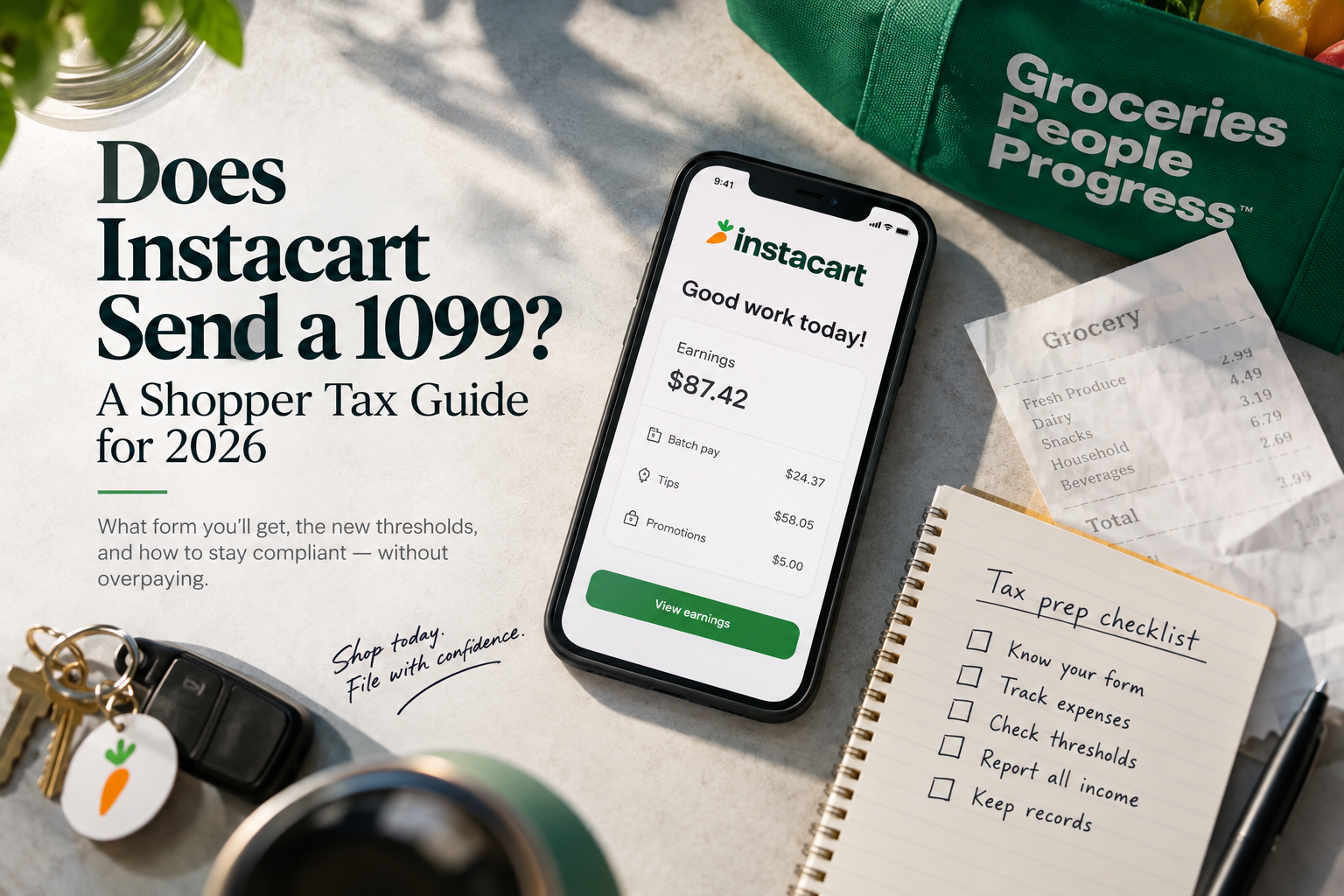
Whether Instacart sends you a 1099 depends on what kind of shopper you are and how much you earned. Receiving one, or not receiving one, doesn’t by itself tell you what you owe. This guide walks through exactly which form applies to you. It also covers the actual 2026 reporting thresholds — several of which changed significantly this year — and what to do whether or not a form ever shows up.
Quick Answer
Instacart can send you a Form 1099-NEC if you’re a full-service shopper. That means someone who both shops and delivers as an independent contractor, once earnings cross the applicable federal reporting threshold. In-store shoppers, by contrast, generally count as Instacart employees and receive a W-2 instead. Not receiving a 1099 doesn’t mean your income is tax-free. The form reports what you were paid, but it doesn’t determine your actual taxable profit. You’re still required to report self-employment income you earned even if no form ever arrives.
Does Instacart Send You a 1099?
It depends on your shopper type. Instacart distinguishes between two roles:
- Full-service shoppers — people who shop for and deliver orders — count as independent contractors. This guide is written for this group, since they’re the ones who can receive a 1099.
- In-store shoppers — who work inside a specific retail location — generally count as Instacart employees. They receive a W-2 with taxes already withheld, the same as any other employer-employee relationship. Their tax situation follows standard employment rules, not the independent-contractor rules covered here.
If you’re a full-service shopper, whether you actually receive a 1099-NEC depends on one thing: whether your total earnings from Instacart crossed the federal reporting threshold for the year. That threshold is covered in detail below.
Which Tax Form Do Instacart Shoppers Receive?
For most full-service shoppers, the relevant form is Form 1099-NEC (Nonemployee Compensation). Since the 2023 tax year, Instacart delivers this form directly through the Shopper app. Before that, it used Stripe Express instead. If you shopped for Instacart in 2021 or 2022, your form from that period may still only be accessible through Stripe. For 2023 and later, go through the Shopper app or contact Instacart support directly.
A Form 1099-K is also possible in some circumstances — it depends on which payment method handled the transaction, not on shopping-and-delivery pay itself. Given the current federal reporting threshold for 1099-K (covered below), this applies to a narrower set of situations than it used to.
1099-NEC vs. 1099-K for Instacart Shoppers
1099-NEC vs. 1099-K: Know the Difference
These forms follow different reporting rules — and neither threshold is a tax-free allowance.
Generally used for compensation paid for services performed by a nonemployee. This is the form most directly relevant to independent-contractor compensation.
For qualifying third-party network transactions, gross payments must exceed $20,000 and the number of transactions must exceed 200.
These two forms report fundamentally different things, and it’s a mistake to treat them as interchangeable.
Form 1099-NEC reports nonemployee compensation. In this context, that means what Instacart paid you directly for shopping and delivery work — including batch payments, tips passed through the platform, promotional bonuses, peak-hour incentives, and referral bonuses. Instacart, operating under its legal entity name (Maplebear Inc.), is the payer.
Form 1099-K reports payments processed through a third-party payment network or settlement organization. It’s tied to how money moved, not specifically to gig work. For a typical full-service shopper being paid directly by Instacart for their labor, 1099-NEC is the form that applies. A 1099-K would only come into play if a portion of your payments moved through a separate third-party network in a way that triggers that form’s own reporting threshold. As the next section covers, that threshold is high enough in 2026 that most individual shoppers won’t cross it through Instacart activity alone.
You could, in principle, receive one form, both, or neither for a given year. It depends on how your specific payments moved and what you earned. Don’t assume you’ll automatically get both just because gig income is involved.
What Are the 2026 Reporting Thresholds?
This is an area where a lot of currently circulating content is out of date, so it’s worth being precise.
The 1099-NEC Threshold
For 2026, the Form 1099-NEC threshold is $2,000. Under the One Big Beautiful Bill Act (OBBBA), this figure replaced the longstanding $600 threshold for payments made during 2026. Inflation adjustments start in 2027. This federal threshold determines when a payer must issue the form. A payer can still choose to issue one below that amount, but nothing obligates them to.
The 1099-K Threshold
For 2026, the Form 1099-K threshold is more than $20,000 in gross payments AND more than 200 transactions. Both conditions apply. This corrects a significant point of confusion. Earlier legislation (the American Rescue Plan Act of 2021) had scheduled this threshold to drop all the way to $600 with no transaction minimum. The IRS planned to phase that in gradually: $5,000 for 2024, $2,500 for 2025, and $600 for 2026. That phase-in never reached its final step.OBBBA repealed it retroactively in July 2025 and restored the original $20,000-and-200-transaction standard for 2025 and all years after. IRS guidance updated that October confirms this. If you’ve seen a “$600” figure attached to 1099-K for 2026, that figure describes a repealed rule — one Congress killed before it ever took effect. It does not describe current law.
What This Means for Instacart Shoppers
The much lower 1099-NEC threshold ($2,000) governs most full-service shopper income. That’s because Instacart pays you directly rather than acting as a settlement intermediary between you and a separate payer. The restored, much higher 1099-K threshold now applies to a narrower set of circumstances than many older gig-tax guides still describe.
One more wrinkle worth knowing: the IRS itself notes that a lower state-specific threshold can trigger a platform’s reporting obligation, even when the federal $20,000/200-transaction bar isn’t met. Several states currently set their own lower 1099-K reporting threshold, commonly cited around $600. If you live in one of those states, you could still receive a 1099-K well below the federal figure. Check your specific state’s rule rather than assuming the federal threshold is the only one that applies to you.
What If Instacart Doesn’t Send You a 1099?
Not receiving a 1099 does not mean your Instacart income is tax-free. Federal law bases taxability on whether you earned the income, not on whether a specific form arrived. The reporting threshold determines a payer’s paperwork obligation — it has nothing to do with your obligation to report what you actually earned.
If no form arrives, or you earned under the threshold that would trigger one, here’s what to do:
- You’re still generally required to report the income on your tax return.
- Reconstruct your earnings using your own records. The Instacart Shopper app’s payment history, weekly or batch payment summaries, and your bank deposit records are all reasonable starting points.
- Don’t estimate or guess at a round number; work from actual documented payments.
- If you believe Instacart should have issued you a form and it never arrived, contact Instacart support before assuming none is coming. You can also check the Shopper app’s tax document section.
If a 1099 you did receive looks wrong — an incorrect total, a data entry issue — contact the issuer to request a correction. Don’t quietly adjust the number yourself without documentation.
Where Can You Find Your Instacart Tax Forms?
For the 2023 tax year onward, Instacart delivers 1099 forms directly through the Shopper app rather than Stripe Express. If you don’t see it there by early February, check for an email from Instacart, including spam and junk folders. Confirm the email and mailing address on file are current, and contact Instacart support directly if it still hasn’t appeared. For tax years 2021 and 2022 specifically, forms may still be accessible only through Stripe Express rather than the current app-based system.
Does a 1099 Show What You Actually Owe in Tax?
No — and this is one of the most important distinctions in this entire guide. A 1099 reports gross payments, not your taxable profit. If Instacart paid you $9,500 over the year, that $9,500 is what appears on the form. It is not, however, the number that determines your self-employment tax or income tax.
Legitimate business expenses — mileage, supplies, a portion of your phone bill, and other costs covered below — reduce that gross figure down to a net profit on Schedule C. Self-employment tax then applies to that net figure, after a further adjustment, not to the gross amount on the 1099. Treating “15.3% of my 1099” as your self-employment tax bill significantly overstates what you actually owe. That’s true once you account for real business expenses.
Are Instacart Tips Tax-Free Under the New OBBBA Rules?
Not entirely, and it’s worth being precise about what actually changed. The One Big Beautiful Bill Act (OBBBA) created a new federal income tax deduction — sometimes called “No Tax on Tips” — for qualified tips received in tax years 2025 through 2028. Treasury and the IRS published final regulations (T.D. 10044) in April 2026, confirming the mechanics and the list of qualifying occupations.
How the Deduction Works
Eligible workers can deduct up to $25,000 in qualified tips per year directly from their federal taxable income, whether or not they itemize. The deduction phases out as income rises. It’s reduced by $100 for every $1,000 that modified adjusted gross income exceeds $150,000 for single filers, or $300,000 for joint filers. Both W-2 employees and self-employed workers can potentially qualify. But only if their occupation is on the IRS’s list of jobs that customarily and regularly received tips before the end of 2024. That list explicitly includes transportation and delivery work — couriers and delivery drivers whose customers customarily tip. That category reasonably describes the delivery side of full-service Instacart shopping, though no source available for this article names Instacart by name in the official occupation list itself.
What It Doesn’t Change
Here’s the part most likely to get misunderstood: this deduction reduces federal income tax only. It does not reduce or eliminate self-employment tax. You still calculate self-employment tax on your net earnings from self-employment the normal way. That includes the portion of your profit that came from tips. You apply the qualified tips deduction afterward, on your income tax return, not before. A shopper with $3,000 in qualifying tips as part of their Instacart earnings still owes SE tax on that $3,000, net of the usual 92.35% adjustment. That’s the same treatment as any other portion of their profit. What changes is that up to that amount may not count toward their federal income tax bill, subject to the MAGI phaseout above.
Reporting Still Matters
You still need to report tips as part of your overall Instacart earnings. This deduction doesn’t create a separate, unreported category of income. For a full-service shopper, the gross figure Instacart reports on your 1099-NEC generally already includes tips passed through the platform. You claim the deduction separately on your tax return, not by leaving tip income off your books. State tax law doesn’t automatically follow federal changes, either. Whether your state also exempts qualified tips from state income tax depends entirely on whether your state has chosen to conform to this federal provision. Check your specific state’s rules rather than assuming your state return works the same way.
Common Instacart Business Expenses
Full-service shoppers generally have legitimate business expenses tied to the work. What’s actually deductible depends on real business purpose, documentation, and — for anything with personal use mixed in — separating the business portion from the personal portion. Categories worth tracking:
- Business mileage for driving related to shopping and delivering orders (detailed in the next section)
- Parking and tolls directly tied to completing orders
- The business-use portion of your phone, if it’s also used personally — not the full bill
- Insulated bags and delivery equipment used for the work
- Supplies genuinely used in the course of shopping/delivery work
- Other ordinary and necessary costs directly tied to the business
None of these are automatically deductible just because you’re an Instacart shopper — the expense has to genuinely relate to the business, the personal-use portion of any mixed-use item isn’t deductible, and documentation (receipts, mileage logs, records of business purpose) matters if the deduction is ever questioned.
How Mileage Works for Instacart Shoppers
Mileage is typically the largest deductible expense for a full-service shopper. And 2026 has a wrinkle worth knowing about: the IRS increased the standard business mileage rate mid-year. The rate was 72.5 cents per mile for the first half of 2026 (January 1 through June 30). It then increased to 76 cents per mile for the second half (July 1 through December 31) — a genuinely unusual mid-year change, driven by rising fuel costs. If you’re using the standard mileage method for 2026, your mileage log needs to reflect both rates for the respective periods, not one flat rate applied to the whole year.
Only business mileage — driving actually related to shopping and delivering orders — counts. Ordinary commuting to a general starting location isn’t automatically deductible the way active delivery driving is. Personal errands mixed into a shift aren’t business mileage just because they happened between orders. Keeping a contemporaneous log (date, purpose, miles) is far stronger support than reconstructing mileage from memory later.
One Year. Two Mileage Rates.
Instacart shoppers using the standard mileage method need to split qualifying 2026 business miles into two periods.
What If You Also Drive for DoorDash or Uber?
If you work multiple gig platforms, each one generally issues its own tax forms independently. Each is based on its own payments to you and the applicable thresholds — Instacart’s 1099-NEC doesn’t account for DoorDash or Uber income, and vice versa. Your actual tax return depends on your combined self-employment activity instead. Income from every platform generally gets reported together, and your own records need to reconcile gross payments and fees across all of them. Thresholds like the $2,000 1099-NEC figure apply per payer, not as a combined “tax-free allowance” across all your gig income put together. EarnerLedger’s guide to tracking income and expenses across multiple gig apps walks through the full reconciliation process.
What If Instacart Is a Side Hustle and You Have a W-2 Job?
Instacart income remains fully relevant to your taxes even if it’s secondary to a regular job. Your employer calculates W-2 withholding based on your job’s wages alone, and it doesn’t automatically account for the additional self-employment tax and income tax your Instacart earnings generate. One practical option: you can request additional withholding from your W-2 paycheck (via Form W-4) specifically to help cover the tax your Instacart income creates, as an alternative to managing separate quarterly payments. EarnerLedger’s dedicated guide on self-employment tax with a W-2 job covers how W-2 wages interact with self-employment tax, including the Social Security wage base, in much more depth.
Do Instacart Shoppers Need to Pay Quarterly Taxes?
Potentially, depending on your overall expected tax liability for the year — not simply because you drive for Instacart. The general federal trigger is expecting to owe $1,000 or more in tax for the year after subtracting withholding and credits. That’s evaluated against your full tax picture, including any W-2 withholding you already have, not your Instacart income in isolation. EarnerLedger’s guide on how to pay quarterly estimated taxes as a freelancer covers this calculation in full.
Example 1: Part-Time Instacart Shopper
Assume $9,500 in gross Instacart payments for the year, with documented mileage and other business expenses.
| Item | Amount |
|---|---|
| Gross Instacart payments (per 1099-NEC) | $9,500 |
| Mileage deduction (1,100 miles × $0.725, Jan–Jun; 1,100 miles × $0.76, Jul–Dec) | ≈ $1,634 |
| Other business expenses (bags, supplies, phone portion) | $350 |
| Schedule C net profit | ≈ $7,516.50 |
That figure — not the $9,500 gross amount from the 1099 — is what flows to Schedule SE to determine self-employment tax, since it clears the $400 net-earnings threshold. EarnerLedger’s guide to calculating self-employment tax walks through that next step in detail. This example doesn’t calculate the exact SE tax or income tax owed, since that depends on filing status, other income, and deductions not assumed here. The point is simpler: the gap between the gross number on the form and the net figure taxes are actually based on.
Example 2: W-2 Job + Instacart
Assume $52,000 in W-2 wages and $4,200 in net Instacart profit after expenses, filing single.
Because $52,000 is well under the 2026 Social Security wage base, the Instacart earnings don’t run into any wage-base capping. The self-employment tax on that $4,200 in net profit follows the standard calculation, without the reduction that can apply at much higher combined income levels. What changes in this scenario isn’t the self-employment tax mechanics themselves — it’s the fact that this shopper’s W-2 withholding wasn’t designed to cover the additional tax the Instacart income generates. They may need to either increase their W-2 withholding or make estimated payments to avoid an underpayment surprise.
Common Instacart Tax Mistakes
- Assuming no 1099 means no taxable income — it doesn’t; the threshold governs paperwork, not taxability.
- Treating the gross figure on a 1099-NEC as taxable profit, instead of subtracting legitimate business expenses first.
- Repeating an outdated $600 threshold for 1099-K — Congress repealed that rule before it ever took effect for 2026.
- Confusing 1099-NEC with 1099-K as if they report the same thing.
- A mileage log reconstructed from memory at tax time, instead of one kept contemporaneously.
- One flat mileage rate applied to all of 2026, missing the mid-year rate change.
- W-2 withholding assumed to automatically cover Instacart taxes when Instacart is a side hustle.
- In-store and full-service shopper tax situations treated as identical, when they follow entirely different rules (W-2 vs. independent contractor).
Frequently Asked Questions
Forms and Reporting
Does Instacart send a W-2 or 1099? It depends on your role. Instacart classifies in-store shoppers as employees, so they receive a W-2. Full-service shoppers work as independent contractors and may receive a 1099-NEC instead.
How much do you have to make on Instacart to get a 1099? For 2026, the federal 1099-NEC reporting threshold is $2,000. Below that, Instacart doesn’t have to issue the form, though your income is still reportable.
Do I report Instacart income if I didn’t get a 1099? Yes. Taxability doesn’t depend on receiving a form — you still generally need to report income you actually earned.
Where do I find my Instacart 1099? For 2023 and later tax years, check the Shopper app. For 2021–2022, you may only be able to access it through Stripe Express.
Does Instacart report income to the IRS? Instacart, as the payer, generally reports nonemployee compensation that meets the 1099-NEC threshold to the IRS, the same way any business reports payments to independent contractors.
What if my 1099 amount looks wrong? Contact Instacart to request a correction rather than adjusting the figure yourself without documentation.
Taxes and Money
Can I deduct mileage for Instacart? Yes, for genuine business mileage tied to shopping and delivering, using either the standard mileage rate (72.5 cents per mile for the first half of 2026, 76 cents for the second half) or the actual expense method — not for commuting or personal driving.
Are my Instacart tips tax-free now under the new tips deduction? Not entirely. A new federal deduction lets eligible workers in qualifying occupations, including delivery work, deduct up to $25,000 in tips from federal income tax through 2028. It doesn’t reduce self-employment tax, though, and you still need to report tips as part of your overall earnings.
Do Instacart shoppers pay self-employment tax? Full-service shoppers generally do, once net earnings from self-employment reach $400 for the year. That figure comes from net profit after business expenses, not gross Instacart payments.
Do I need quarterly estimated taxes? Potentially, depending on your total expected tax liability for the year across all income sources — not automatically just because you shop for Instacart.
Bottom Line
Whether Instacart sends you a 1099 depends on your shopper classification and whether your earnings crossed the applicable 2026 threshold. That’s $2,000 for Form 1099-NEC, not the often-repeated but now-repealed $600 figure. Either way, the form you do or don’t receive reports gross payments, not your actual taxable profit, and it has no bearing on whether you need to report the income. Track your own earnings and expenses regardless of what paperwork does or doesn’t arrive. Treat the 1099 as a data point to reconcile against your own records, not as the final word on what you owe.
This article is for general educational purposes and reflects federal tax guidance in effect for the 2026 tax year at the time of writing. It is not individualized tax advice, and it does not describe every possible Instacart payment scenario. Consult a CPA, enrolled agent, or other qualified tax professional for guidance specific to your situation.
Official Sources
- IRS — About Form 1099-NEC, Nonemployee Compensation
- IRS — About Form 1099-K, Payment Card and Third Party Network Transactions
- IRS Fact Sheet 2025-08 (October 23, 2025) — confirming the OBBBA repeal of the ARPA $600 Form 1099-K phase-in and restoration of the $20,000/200-transaction threshold
- One Big Beautiful Bill Act, Section 70432 (1099-K threshold restoration) and the separate provision raising the 1099-NEC/1099-MISC threshold to $2,000 for 2026
- IRS — Self-employment tax (Social Security and Medicare taxes); Self-Employed Individuals Tax Center ($400 net-earnings threshold)
- IRS — 2026 standard mileage rate announcements (Notice 2026-10; Announcement 2026-11, mid-year increase effective July 1, 2026)
- Stripe Support — Guide to 1099 Tax Forms for Instacart Shoppers (for the Stripe-to-Shopper-app transition timeline)
- Treasury/IRS Final Regulations, T.D. 10044 (published April 13, 2026) — “Occupations that Customarily and Regularly Received Tips; Definition of Qualified Tips,” implementing IRC Section 224 (the OBBBA qualified tips deduction)
FACT-CHECK NOTES
Nota: esta sección es material de trabajo para el editor, no contenido pensado para publicarse en el artículo en vivo. Si la pegas en WordPress junto con el resto para pasar Yoast, considera quitarla del post final antes de publicar.
Threshold Table
| FACT | CURRENT 2026 VALUE / RULE | PRIMARY SOURCE | VERIFIED TODAY? |
|---|---|---|---|
| 1099-NEC federal reporting threshold | $2,000 (up from $600) | OBBBA statutory provision; corroborated by multiple independent professional tax sources describing identical figures and effective dates | Yes — re-confirmed in this research round |
| 1099-K federal reporting threshold | More than $20,000 AND more than 200 transactions (NOT $600) | Confirmed via direct fetch of irs.gov itself (“Understanding your Form 1099-K” and “Form 1099-K FAQs: General information”), corroborated by OBBBA Section 70432 and IRS Fact Sheet 2025-08 (Oct. 23, 2025) via multiple independent secondary sources | Yes — verified directly against IRS.gov text in this round |
| State-level 1099-K thresholds can be lower than the federal figure (e.g., several states cited around $600) | Confirmed at the general-rule level directly on irs.gov (“your state may have a lower reporting threshold”); specific state list corroborated only by secondary sources | irs.gov (general rule); secondary sources (specific states) | Partially — the existence of the rule is IRS-confirmed; the specific state list is not |
Self-Employment and Mileage Table
| FACT | CURRENT 2026 VALUE / RULE | PRIMARY SOURCE | VERIFIED TODAY? |
|---|---|---|---|
| $400 net-earnings threshold for self-employment tax | Unchanged, stable federal rule | Previously verified directly against irs.gov in EarnerLedger’s Self-Employment Tax pillar article | Yes (reused from prior verified research) |
| 92.35% net-earnings adjustment; 15.3% combined SE tax rate | Unchanged, stable federal rule | Previously verified directly against irs.gov | Yes (reused from prior verified research) |
| 2026 Social Security wage base | $184,500 | Previously verified directly against the 2026 Form 1040-ES | Yes (reused from prior verified research) |
| 2026 standard mileage rate | 72.5 cents/mile (Jan 1–Jun 30); 76 cents/mile (Jul 1–Dec 31) | IRS Announcement 2026-11 modifying Notice 2026-10; previously verified via direct fetch of the announcement text in prior EarnerLedger research; re-corroborated in this round | Yes |
| $1,000 threshold for owing estimated tax | Unchanged, stable federal rule | Previously verified directly against the 2026 Form 1040-ES | Yes (reused from prior verified research) |
Instacart-Specific and Tips-Related Facts
| FACT | CURRENT 2026 VALUE / RULE | PRIMARY SOURCE | VERIFIED TODAY? |
|---|---|---|---|
| Instacart shopper classification (full-service = independent contractor/1099; in-store = employee/W-2) | Current practice per multiple independent shopper-facing tax guides | Not IRS-sourced (this is an Instacart business-practice fact, not a tax rule); corroborated by multiple independent sources including Stripe’s own support documentation for Instacart | Partially — corroborated by several independent sources but not confirmed directly against an official Instacart policy page in this research round |
| Instacart delivers 1099 forms via Shopper app (not Stripe Express) since 2023 | Current process | Stripe’s own support page for Instacart shoppers, corroborated by multiple independent sources with consistent detail | Yes |
| OBBBA “Qualified Tips” federal income tax deduction | Up to $25,000/year, tax years 2025–2028; MAGI phaseout starting at $150,000 (single)/$300,000 (joint); reduces federal income tax only, NOT self-employment tax; occupation must be on the IRS’s finalized list (which includes transportation/delivery work) | IRC §224; Treasury/IRS Final Regulations T.D. 10044 (April 13, 2026); corroborated independently by RSM US, BDO, and Ogletree | Yes, added in this review round — this is a genuinely new 2026 provision that was entirely absent from the prior draft; Instacart’s specific inclusion in the named occupation list was not independently confirmed and is presented as probable, not certain |