
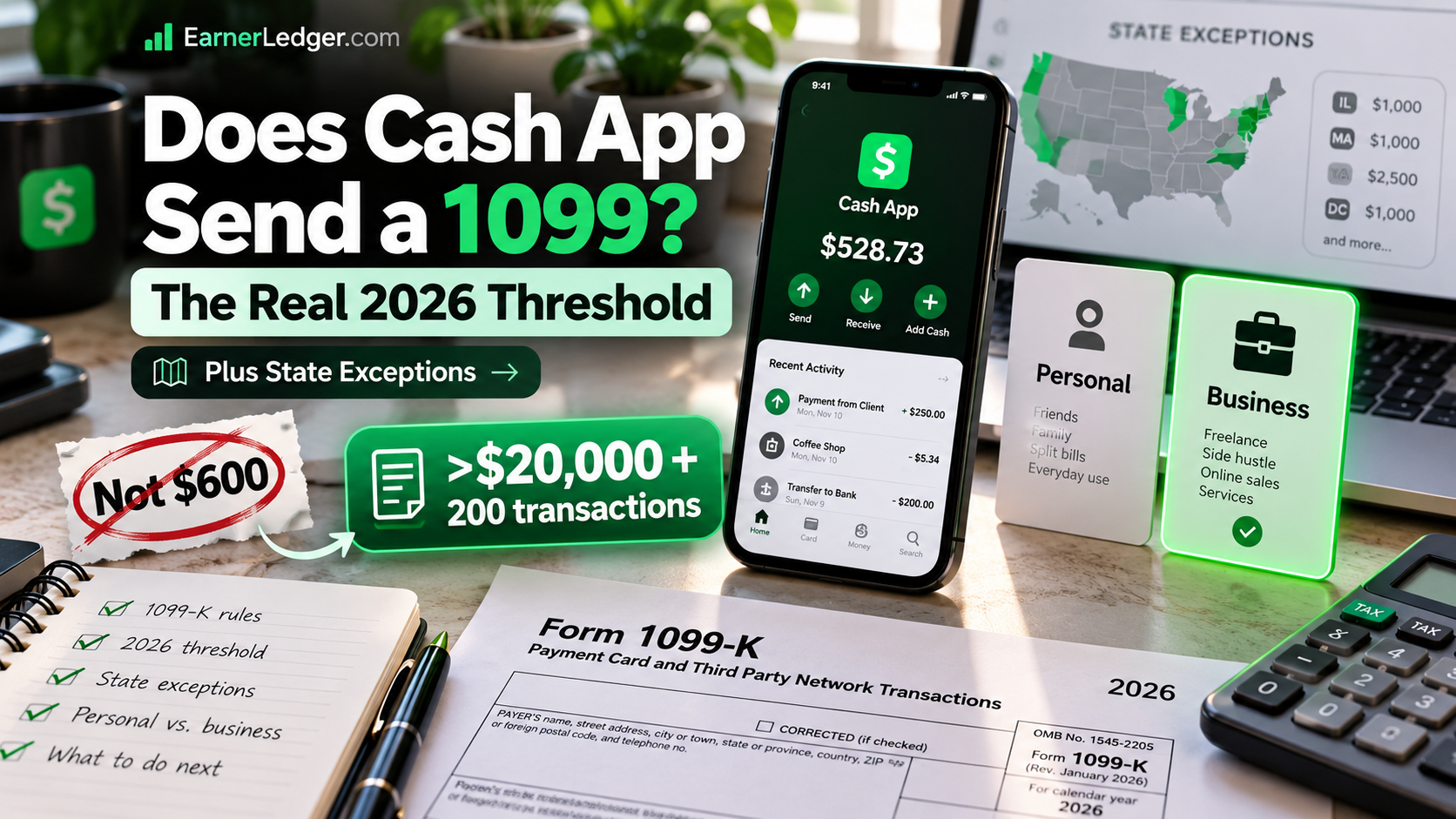
Cash App can send you a Form 1099-K, but only through a Cash App Business account. Personal transfers between friends and family don’t trigger one. For 2026, the federal threshold for a Business account is more than $20,000 in gross payments and more than 200 transactions — both conditions required. A handful of states set their own lower threshold. That means you can receive a 1099-K below the federal figure, depending on where you live.
The Short Answer
Cash App issues a 1099-K for payments received through a Business account once you cross the federal threshold, or a lower state threshold if one applies to you. Personal transfers — splitting dinner, paying back a friend, family reimbursements — generally aren’t reportable on a 1099-K at all. Getting a 1099-K also doesn’t automatically mean the full amount is taxable profit. It reports gross payments only, not your actual income.
Cash App 1099-K Threshold for 2026
| Account type | Federal threshold | 1099-K possible? | Notes |
|---|---|---|---|
| Personal account | Not applicable | Generally no | Ordinary transfers between individuals aren’t reportable |
| Business account | $20,000+ and 200+ transactions | Yes | Both conditions required together |
| Former Business account, now Personal | Based on activity during the Business period | Yes, if threshold was met | Switching later doesn’t erase the earlier reporting obligation |
Why Some Sites Still Say $600 or $5,000
Federal legislation in 2021 scheduled the 1099-K threshold to drop toward $600, with no transaction minimum. The IRS phased that drop in gradually rather than applying it all at once. A $5,000 transitional figure applied along the way. That phase-in never reached its final step. The One Big Beautiful Bill Act, enacted in 2025, restored the original $20,000/200-transaction threshold. Some content online still describes the old phase-in numbers — written before the restoration, never updated since.
Personal vs. Business Cash App Accounts
This distinction matters more than the dollar threshold itself. Cash App marks Business accounts with a business profile indicator, distinct from a standard personal account. Payments flowing through a Business account for goods or services count toward the 1099-K threshold. Personal transfers — even large ones, even frequent ones — generally don’t. That holds as long as they represent genuine personal transactions rather than payments for goods or services.
Switching your account type doesn’t retroactively change what earlier transactions were. A payment that was genuinely personal stays personal. A payment that was genuinely business activity stays business, regardless of which account type you’re using today.
What If You Switched From Personal to Business Mid-Year?
Payments received after switching to a Business account count toward the threshold from that point forward. Payments received while the account was Personal generally don’t count toward 1099-K reporting. Personal transfers fall outside that system in the first place.
The reverse situation matters too. Say you had a Business account, met the reporting threshold during that period, and later switched to Personal or closed the account. Cash App’s own documentation confirms you’ll still receive a 1099-K for that earlier Business activity. Switching account types afterward doesn’t cancel a reporting obligation that already applied.
State Reporting Thresholds
A handful of states set their own 1099-K threshold, lower than the federal figure, and Cash App follows those independently of the federal rule.
State 1099-K Thresholds (Below the $20,000 Federal Rule)
Straight from Cash App’s own tax documentation
These are the state thresholds Cash App currently lists. State rules can change, so confirm your specific state’s current requirement directly rather than assuming it stays fixed year to year.
What Does Cash App’s 1099-K Actually Report?
The 1099-K reports gross payments received through your Business account — the total before Cash App’s own fees come out. This is not the same number as your taxable profit. Legitimate business expenses still need to come out first, before you arrive at the figure your tax actually gets calculated on.
What About Refunds?
Gross payment totals on a 1099-K generally reflect the original payments received. They don’t automatically adjust for refunds you issued afterward. Say a Business account received $32,000 in gross payments for the year, and $1,000 of that got refunded to customers later. The 1099-K may still show $32,000, even though the business’s actual retained revenue was different once those refunds went out. This doesn’t mean you owe tax on the refunded amount. It means your own business records need to account for refunds separately when you calculate net income, rather than assuming the 1099-K figure already reflects them.
Cash App Personal Payments
Splitting a dinner bill, reimbursing a roommate for rent, family gifts, and repaying money a friend covered for you are all ordinary personal transfers. Money moving through Cash App doesn’t automatically become taxable income just because it passed through a payment app. What matters is what the payment actually represents, not which app processed it.
Selling Personal Items Through Cash App
If you sold a personal item and the payment landed on a 1099-K, taxability still depends on what you sold it for relative to what you originally paid — not on the 1099-K figure itself. EarnerLedger’s guide to personal items sold at a loss covers this mechanic directly, including the current IRS reporting method for a loss that generates no taxable gain.
What If Cash App Sends Me a 1099-K by Mistake?
Compare the form against your own transaction records first. Something might look wrong — an amount that doesn’t match your actual activity, or a form you don’t think should have been issued. Contact Cash App directly to request a correction. Don’t simply ignore an incorrect form. The IRS already has a copy, and unresolved discrepancies can create confusion at filing time.
Worked Examples
Example 1: $12,000 through a personal account, transferred between friends and family. This generally isn’t Business 1099-K activity at all. Personal transfers fall outside the reporting system regardless of the dollar amount, as long as they’re genuinely personal.
Example 2: $14,000 through a Business account, across 120 transactions. Neither federal condition is met — the total sits under $20,000, and the transaction count sits under 200. No federal 1099-K applies, though a state exception could still trigger one depending on where the account holder lives.
Example 3: $28,000 through a Business account, across 260 transactions. Both federal conditions are met. Cash App issues a 1099-K reporting the full $28,000 in gross payments.
Example 4: $40,000 through a Business account, across 140 transactions. This is the scenario people most often get wrong. The dollar amount clears $20,000 by a wide margin, but the transaction count falls short of 200. Both conditions have to be met together, so no federal 1099-K applies here either. Exceeding the dollar threshold alone isn’t sufficient.
Does Getting a 1099-K Mean I Owe Tax?
No. A 1099-K is an information return, not a calculation of what you owe. Taxability depends entirely on what the underlying payments represent — genuine business revenue, a personal reimbursement, a personal item sold at a gain, or a personal item sold at a loss all get treated differently, even if they happened to land on the same form. EarnerLedger’s guide to personal items sold at a loss walks through that distinction with full worked examples.
Common Mistakes
- Assuming $600 is the 2026 threshold. It describes a rule that was reversed before this tax year began.
- Assuming $20,000 alone triggers a 1099-K. The 200-transaction requirement has to be met too.
- Treating personal transfers as automatically taxable, simply because they moved through Cash App.
- Ignoring state-level thresholds that can trigger a form below the federal figure.
- Treating the 1099-K’s gross total as taxable profit, without subtracting real business expenses or accounting for refunds.
- Ignoring a 1099-K after switching from Business to Personal. Earlier Business-period activity can still generate one.
- Mixing personal and business transactions in the same account without clear records separating them.
Frequently Asked Questions
Does Cash App send a 1099 in 2026? Yes, but only through a Business account, and only once federal or state thresholds are met. Personal accounts generally don’t receive one.
What is the Cash App 1099 threshold for 2026? More than $20,000 in gross payments and more than 200 transactions federally, with several states setting a lower threshold.
Does Cash App report personal payments to the IRS? Generally no. Personal transfers between individuals fall outside the 1099-K reporting system, regardless of amount.
Are family and friends payments reported too? No, as long as those payments are genuine personal transfers rather than payment for goods or services.
What about a Cash App Business account specifically? It sends a 1099, once the federal or an applicable state threshold is met for that account.
Will I get a 1099 if I make less than $20,000? Generally not federally, though a lower state threshold could still apply depending on where you live.
Does the 200-transaction rule still apply? Yes. Both the dollar amount and the transaction count have to be met together for the federal threshold.
What if I switched from Business to Personal? You can still receive a 1099-K for activity from when the account was a Business account, even after switching.
What if I switched from Personal to Business? Only payments received after the switch count toward the Business account’s threshold.
Does Cash App send a 1099 for selling personal items? It can, if the payment lands on a 1099-K through a Business account. Whether you owe tax depends on whether the item sold for a gain or a loss, not on the form itself.
What if my Cash App 1099-K is wrong? Contact Cash App directly to request a correction rather than adjusting the figure yourself without documentation.
When does Cash App send tax forms? Generally by the standard early-year deadline for the prior tax year, consistent with general IRS filing timelines for information returns.
Does a 1099-K mean I owe tax? No. It’s an information return. What you actually owe depends on what the underlying payments represent.
Bottom Line
Cash App only issues a 1099-K through a Business account, once you cross $20,000 and 200 transactions federally. That’s not the $600 figure some content still describes. A handful of states, including Missouri at a distinct $1,200 threshold, can trigger a form below that federal figure. Personal transfers stay outside this system entirely. Switching account types doesn’t erase an earlier reporting obligation, and receiving a 1099-K never automatically means the full amount is taxable.
This article is for general educational purposes and reflects federal tax guidance in effect for the 2026 tax year at the time of writing. It is not individualized tax advice. Consult a CPA, enrolled agent, or other qualified tax professional for guidance specific to your situation.