Do Freelancers Need Business Insurance? Types of Coverage Explained

Business insurance for freelancers is not governed by one universal U.S. rule. A freelancer may have no legal requirement to buy a standard general liability policy, while another may need coverage because of state workers’ compensation law, commercial vehicle use, professional licensing, a lease, or a client contract. The practical question is therefore not simply, “Do … Read more


Can Freelancers Get a Business Credit Card? Requirements and What Issuers Look For

A business credit card for freelancers can be available even if you operate as a sole proprietor, have no employees, and have never formed an LLC. In other words, freelancers do not need to become a large or formally incorporated company before they can potentially apply for business credit. Approval still depends on the issuer’s underwriting, and … Read more

Can Self-Employed Workers Get a Mortgage? What Lenders Look For

A self-employed mortgage is not a special type of home loan. It is a mortgage underwritten using self-employment income instead of relying mainly on a traditional employer’s pay stubs and W-2s. Freelancers, sole proprietors, independent contractors, and business owners can qualify for conventional and government-backed mortgages when their income is stable, documented, and sufficient for the loan. … Read more

Solo 401(k) Contribution Limits for 2026: How Much Can You Contribute?

For 2026, a Solo 401(k) participant can generally defer up to $24,500 as an employee and may also make an employer contribution, subject to earned income and the plan’s terms. Total annual additions are generally capped at $72,000 before catch-up contributions. Those published limits are ceilings, not automatic contribution amounts. A self-employed person’s actual Solo 401(k) contribution depends on … Read more

Solo 401(k) vs SEP IRA: Which Is Better for Self-Employed Workers?

A Solo 401(k) and a SEP IRA can both help self-employed workers save for retirement, but they work very differently. A Solo 401(k) often allows a larger contribution at lower and moderate income because the owner can contribute in two roles — as employee and employer — while a SEP is built around employer contributions … Read more

Schedule C Explained: How Freelancers Report Business Income and Expenses

Schedule C is the federal tax form many freelancers and sole proprietors use to turn business activity into a net profit or loss. It starts with business income, subtracts allowable business expenses, and produces a figure that feeds into the taxpayer’s broader federal return. For freelancers, that number can affect federal income tax, self-employment tax, … Read more

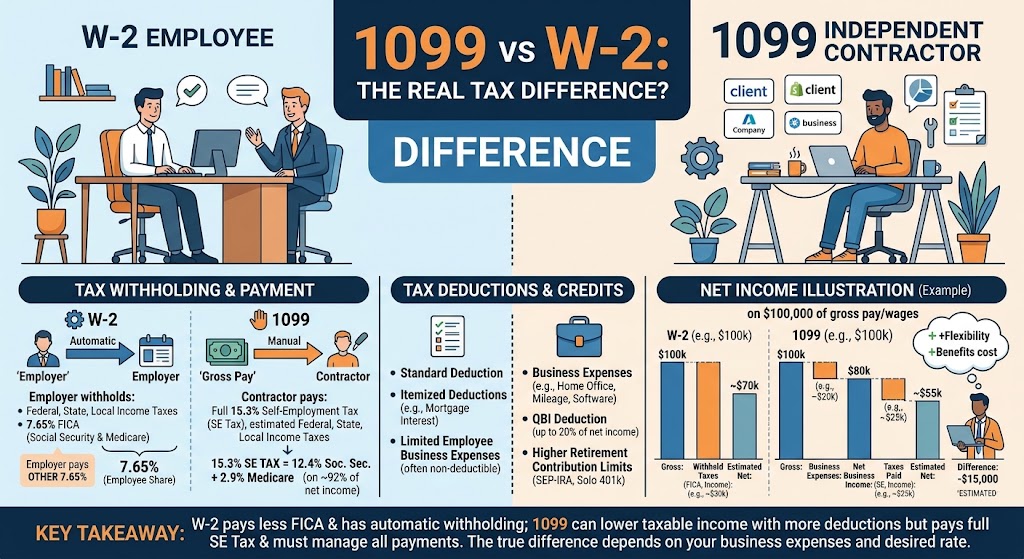
1099 vs W-2: What’s the Real Tax Difference?

W-2 employees generally have federal income tax and payroll taxes withheld from each paycheck, while independent contractors usually receive payments without regular federal withholding and handle their own tax payments. Employers also generally pay a matching share of Social Security and Medicare taxes for employees; self-employed workers generally cover both shares through self-employment tax. That … Read more

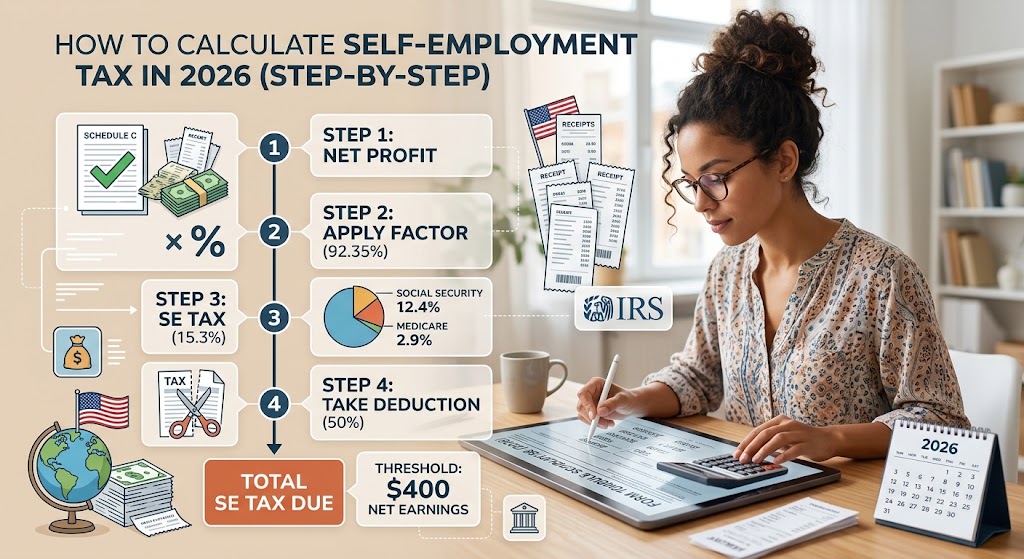
How to Calculate Self-Employment Tax in 2026 (Step-by-Step)

If you’re self-employed, self-employment tax is generally a separate federal tax in addition to regular income tax. For many freelancers, it is calculated by applying the 12.4% Social Security and 2.9% Medicare rates to 92.35% of net self-employment profit—not gross revenue. The Social Security portion is capped, W-2 wages can reduce how much of your self-employment … Read more